

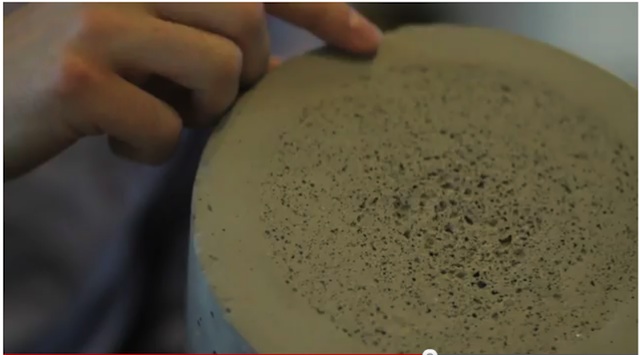
MIT graduate student Steven Keating in the Mediated Matter Group is experimenting with “printing” concrete with variable density as it would allow the properties of the concrete itself to vary continuously,
producing structures that are both lighter and stronger than
conventional concrete, by making it porous in the center and solid on the exterior, just like bones.
To illustrate this, Keating uses the example of a palm tree compared to a
typical structural column. In a concrete column, the properties of the
material are constant, resulting in a very heavy structure. But a palm
tree’s trunk varies: denser at the outside and lighter toward the
center. As part of his thesis research, he has already made sections of
concrete with the same kind of variations of density.
“Nature
always uses graded materials,” Keating says. Bone, for example, consists
of “a hard, dense outer shell, and an interior of spongy material. It
gives you a high strength-to-weight ratio. You don’t see that in
man-made materials.” Not yet, at least.
This may also have benefits to to make concrete structures to have inherent insulation, to channel, store and filter water, the possibilities are truly exciting.
Via MIT
Very interesting indeed. Different densities are probably achievable with Shapeways: actually, according to one of my models, sintered and unsintered material seems to have different densities for White Strong and Flexible. I will try to give you a more precise update on that topic during the next month (hopefully).
We have seen 3D Printed experiments in variable structures in concrete and the potential it has for creating intelligent structures for architecture. Netfabb have recently uploaded a really simple, interesting video of the capillary effects of