
Defense supply chains are under increasing strain. Across the industry, organizations are experiencing spare-part shortages, long production lead times, and growing difficulty maintaining critical systems. These challenges are not simply temporary disruptions. They reveal deeper structural issues in how defense components are sourced, manufactured, and delivered.
For decades, defense manufacturing relied on global supply networks optimized for efficiency and scale. While this model worked well in stable economic conditions, today’s environment is far less predictable. Geopolitical tensions, material shortages, and aging equipment platforms are exposing vulnerabilities that traditional manufacturing systems struggle to address.
As discussed in our blog on additive manufacturing for defense, new technologies are beginning to reshape how military supply chains operate. Understanding the root causes of current supply chain failures helps explain why the industry is increasingly exploring more flexible and digital production models.
The Growing Fragility of Traditional Supply Chains
Manufacturers design traditional defense supply chains around predictability. Manufacturers rely on long networks of suppliers that specialize in producing specific components at scale. When everything operates smoothly, this system can be efficient and cost-effective. However, the structure also creates significant dependencies.
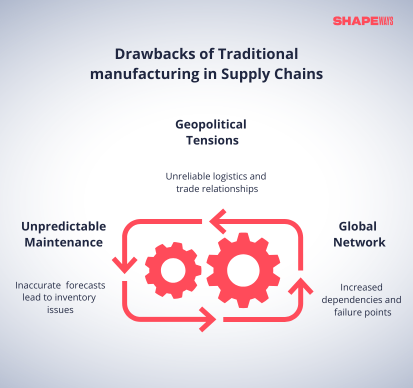
Modern defense programs often involve suppliers spread across multiple countries and regions. Raw materials may come from one location, specialized manufacturing from another, and final assembly somewhere else. This complexity increases the number of potential failure points in the supply chain.
Even a minor disruption can ripple across the system. Transportation delays, supplier shutdowns, or material shortages can halt production entirely. In defense manufacturing, where equipment readiness is critical, these delays can affect maintenance schedules and operational availability.
Globalization and Supply Chain Risk
Globalization has played a significant role in shaping modern manufacturing. By distributing production across different regions, organizations have been able to reduce costs and access specialized expertise. However, this global structure also introduces new risks.
International supplier networks depend on stable logistics systems and predictable trade relationships. When geopolitical tensions rise or transportation networks become disrupted, supply chains can quickly become unreliable.
Defense manufacturing is particularly sensitive to these risks because many components require specialized processes or certifications that only a limited number of suppliers can provide. If a key supplier becomes unavailable, finding an alternative source can take months or even years.
Therefore, these vulnerabilities have led many organizations to reconsider how and where critical components are produced.
The Limitations of Forecasting and Inventory
Managing spare-part inventory presents another challenge for defense supply chains. Military organizations must forecast which parts will be needed years in advance. However, maintenance demands are not always predictable.
Operational conditions, equipment usage, and unexpected failures can all change the types of parts required. When forecasts are inaccurate, organizations either store large quantities of unused components or face shortages when parts are urgently needed.
Maintaining large physical inventories also requires significant storage space and capital investment. At the same time, shortages can delay repairs and reduce equipment availability. This balance between overstocking and understocking highlights the limitations of traditional inventory strategies in complex defense environments.
Moving Toward Digital Manufacturing
To address these challenges, the defense industry is increasingly exploring digital manufacturing approaches. Additive manufacturing enables components to be produced directly from digital design files without the need for specialized tooling. Large-scale manufacturing will continue to play an important role, but digital tools provide new ways to address supply chain gaps and reduce dependencies.
By incorporating digital manufacturing into their supply strategies, organizations can produce parts more quickly, reduce inventory requirements, and improve operational readiness. The ability to manufacture components on demand creates a more agile supply chain capable of adapting to changing conditions.
As the defense industry continues to modernize, technologies that enable distributed and on-demand production will play a growing role in strengthening supply chain resilience.
Interested in how digital manufacturing is reshaping industrial supply chains?
You may also find these resources helpful:
- Additive manufacturing for defense
- Designing Supply Chains for Manufacturing Resilience
- Why Drone Innovation Depends on Smarter Manufacturing
👉 Contact us or explore available materials and manufacturing options with Shapeways