
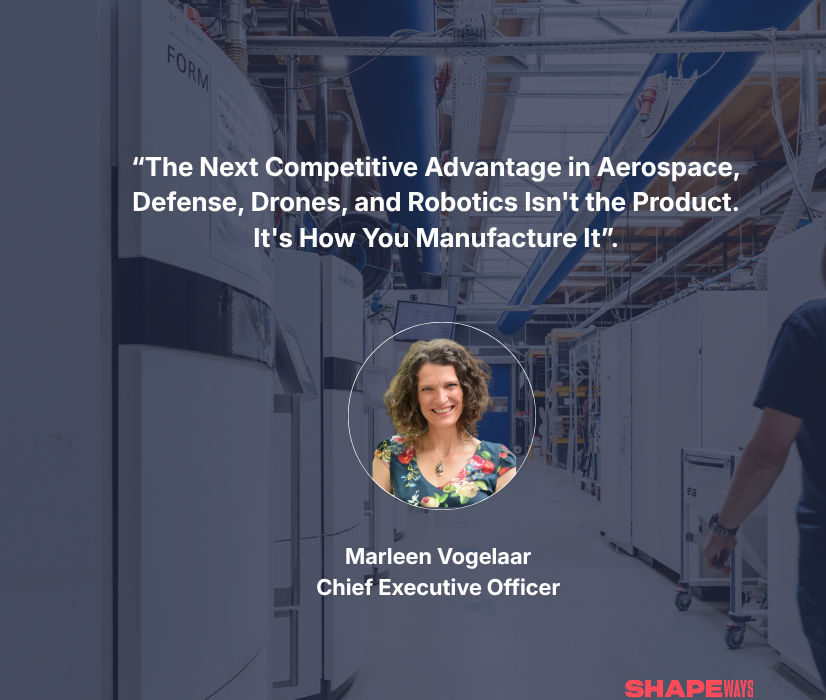
For years, additive manufacturing was viewed primarily as a tool for prototyping.
Today, that conversation is changing.
Across aerospace, defense, drones, and robotics, additive manufacturing is moving beyond the engineering lab and becoming part of core production strategies. Organizations are no longer evaluating whether the technology works. They are determining where it creates the greatest competitive advantage.
This shift is being driven by a common challenge: traditional manufacturing was built for scale, predictability, and long product lifecycles. The industries shaping the future increasingly operate under very different conditions.
They require rapid innovation, highly specialized components, resilient supply chains, and the ability to adapt quickly to changing requirements.
In that environment, manufacturing flexibility becomes a strategic asset.
Why These Industries Are Leading the Shift
Aerospace, defense, drones, and robotics may serve different markets, but they share remarkably similar challenges.
They operate with demanding performance requirements, complex geometries, weight constraints, low-to-medium production volumes, and increasing pressure to accelerate development cycles. Many also face supply chain risks that traditional manufacturing models were never designed to address.
These conditions expose the limitations of conventional production methods.
When every design change requires new tooling, when replacement parts depend on fragile supplier networks, or when product innovation moves faster than manufacturing infrastructure, organizations need a different approach.
That is where additive manufacturing creates value.
Not simply by producing parts differently, but by enabling entirely different ways of designing, producing, and supporting products.
Aerospace and Defense: Building Resilience Into Production
Few industries have pushed additive manufacturing further than aerospace.
Today, the conversation is expanding beyond individual parts.
The focus is increasingly on creating digital manufacturing ecosystems that accelerate qualification, improve traceability, and reduce dependence on traditional supply chains.
Defense organizations are taking this one step further.
As geopolitical uncertainty grows and supply chains face increasing pressure, the ability to manufacture qualified components closer to the point of need has become a strategic advantage. Digital inventories and distributed manufacturing networks offer new ways to improve readiness while reducing logistical complexity.
The opportunity is no longer limited to performance improvement.
It is about resilience.
Drones: Where Speed Becomes a Competitive Advantage
Few industries move as quickly as drones.
Product lifecycles are measured in months rather than years. New payloads, sensors, and mission requirements continuously drive hardware changes. In many cases, development speed determines market success.
Traditional manufacturing struggles to support this pace.
Additive manufacturing enables teams to move from design iteration to functional hardware in days, allowing engineers to test, refine, and deploy improvements without waiting for tooling or lengthy production cycles.
Weight reduction creates an additional advantage.
Lightweight structures, optimized geometries, and part consolidation can directly improve flight performance, increase payload capacity, and extend operational range.
For drone manufacturers, additive manufacturing is increasingly becoming a development and production strategy rather than a prototyping tool.
Robotics: Enabling Customization at Scale
The robotics industry is undergoing its own transformation.
As adoption expands across manufacturing, logistics, healthcare, agriculture, and infrastructure, demand is shifting away from standardized platforms and toward application-specific solutions.
That creates a manufacturing challenge.
Custom end effectors, sensor mounts, housings, brackets, and replacement parts often require low production volumes and frequent design changes. Traditional manufacturing methods struggle to support this level of flexibility economically.
Additive manufacturing thrives in exactly these conditions.
Engineers can rapidly develop, test, and produce custom components without tooling investments or minimum order quantities. As advanced materials continue to evolve, more robotic components are moving from prototype applications into production environments.
For robotics companies, additive manufacturing is becoming a key enabler of both innovation and operational agility.
The Strategic Window Is Open
The most important question is no longer whether additive manufacturing works.
The technology has already proven itself.
The question is how organizations integrate it into their manufacturing strategy.
The companies leading today are not waiting for additive manufacturing to become perfect. They are building expertise, qualifying applications, developing supplier ecosystems, and creating the digital workflows that will define future competitiveness.
That matters because competitive advantage is rarely created when a technology reaches maturity.
It is created during the transition.
Aerospace, defense, drones, and robotics are showing what that transition looks like. They are not simply adopting additive manufacturing. They are redefining how products are designed, produced, and supported throughout their lifecycle.
The organizations that act now will be better positioned to capture the benefits of that shift.
The ones that wait may find themselves competing against companies that have already built the capabilities, knowledge, and agility that modern manufacturing increasingly demands.