
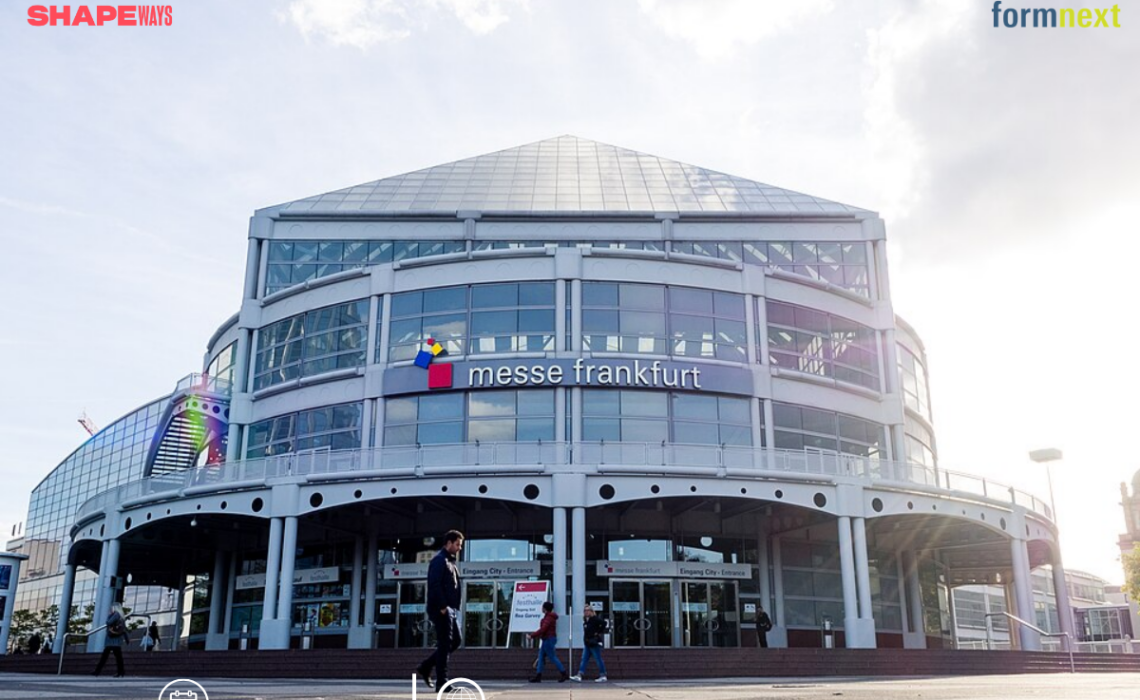
Every November, Frankfurt becomes a global meeting point for additive manufacturing. From November 17–20, Formnext 2026 will bring together manufacturers, technology providers, and industry leaders to explore the latest developments in industrial 3D printing.
But the conversation is evolving. Additive manufacturing (AM) is no longer just about what can be printed. It’s increasingly about how technologies can deliver consistent quality, scalable production, and measurable value across the manufacturing lifecycle.
For companies developing next-generation hardware in medical, defense, robotics, and industrial markets, this shift creates new opportunities to accelerate innovation, improve product performance, and build more resilient supply chains.
Here are seven additive manufacturing trends to watch at Formnext 2026, and what they mean for manufacturers.
1. Industrialization: From Prototyping to Repeatable Production
One of the defining additive manufacturing trends in 2026 is the continued transition from prototyping to industrial production.
While 3D printing has long supported rapid product development, manufacturers are increasingly evaluating it for functional, end-use components. This requires more than printing technology. Repeatability, process control, quality assurance, and traceability are essential.
For manufacturers, the question is changing from “Can we print this part?” to “Can we manufacture it consistently, at the required quality and cost?”
The opportunity for manufacturers
Industrial additive manufacturing can support recurring production of complex components, particularly where traditional tooling is too costly or inflexible.
At Shapeways, our ISO 9001 and ISO 14001 certified quality management and environmental processes support reliable manufacturing. Through established process controls, material testing, and inspection, we help customers transition from individual prototypes to repeatable low-volume production.
The goal isn’t simply to manufacture a part once. It’s to manufacture it reliably throughout its lifecycle.
2. Automation: Making Low-Volume Manufacturing More Efficient
Automation is becoming an increasingly important factor in the industrialization of additive manufacturing.
Advancements in automated build preparation, production planning, powder handling, post-processing, and inspection are helping manufacturers reduce manual intervention and improve consistency.
However, automation isn’t just about producing higher quantities. It’s also about making smaller production runs more efficient and predictable.
The opportunity for manufacturers
For companies developing specialized equipment or next-generation hardware, demand often doesn’t justify large-scale production or significant tooling investments.
Digital and automated manufacturing workflows can help make production in quantities of tens, hundreds, or thousands of parts more practical, depending on the application and process.
Shapeways focuses on flexible, low-volume manufacturing, helping customers produce the quantities they need without committing prematurely to traditional mass-production methods.
This is particularly valuable for robotics, industrial equipment, and specialized hardware manufacturers managing evolving product designs.
3. Design for Additive Manufacturing: Building Better-Performing Products
Design for Additive Manufacturing (DfAM) continues to gain importance as engineers look beyond conventional manufacturing constraints.
By designing specifically for additive processes, manufacturers can explore lighter structures, consolidated assemblies, internal channels, and complex geometries that would be difficult or expensive to produce through traditional methods.
But design freedom alone doesn’t guarantee better products.
The opportunity for manufacturers
Successful DfAM must balance functionality with material properties, tolerances, finishing requirements, production costs, and manufacturability.
For example, consolidating multiple components into a single printed part may simplify assembly and reduce potential failure points. However, another component may benefit more from CNC machining because of its dimensional or mechanical requirements.
At Shapeways, we believe the best manufacturing strategy starts with the application, not the technology.
By combining additive manufacturing, CNC machining, and engineering expertise, we help customers identify the most suitable production approach for their hardware.
The objective isn’t just to make a printable design. It’s to manufacture a better product.
4. Artificial Intelligence: Improving Manufacturing Decisions and Process Control
Artificial intelligence is becoming an increasingly important area of innovation across industrial 3D printing.
AI-enabled software and data analytics are being developed to support design optimization, build preparation, defect detection, predictive maintenance, and process monitoring.
These developments could help manufacturers identify production issues earlier, improve repeatability, and reduce material waste.
The opportunity for manufacturers
For industrial applications, the value of AI lies in making manufacturing processes more predictable and data-driven.
Combining machine data, process monitoring, and quality information can support better production decisions, particularly for companies moving toward recurring manufacturing.
At Shapeways, established production controls, material expertise, and inspection processes already play an important role in manufacturing consistency.
As AI technologies mature, their integration into industrial workflows presents further opportunities to improve efficiency and quality.
The future of manufacturing won’t be defined by AI alone, but by how effectively digital intelligence supports real production processes.
5. Advanced Materials and Sustainability: Choosing the Right Solution
Material innovation continues to expand the possibilities of additive manufacturing.
Developments in engineering polymers, high-performance materials, and metal additive manufacturing are enabling new applications across demanding industries.
At the same time, manufacturers are evaluating how material selection, production waste, energy consumption, and product lifecycle decisions affect their environmental footprint.
The opportunity for manufacturers
Selecting the right material means considering mechanical strength, thermal resistance, chemical compatibility, dimensional stability, weight, and surface finish.
Technologies such as Selective Laser Sintering (SLS) and Multi Jet Fusion (MJF) provide manufacturing options for complex polymer components, while CNC machining offers alternatives when tighter tolerances or specific material properties are required.
Shapeways helps customers evaluate these trade-offs and select materials and processes based on application requirements.
Through our ISO 14001 environmental management framework, we also work to support responsible manufacturing operations.
Sustainable manufacturing requires a lifecycle perspective. Additive manufacturing can reduce waste or eliminate tooling in certain applications, but the environmental benefits depend on the material, process, production volume, and application.
6. Digital Supply Chains: From Physical Inventory to On-Demand Manufacturing
Supply chain resilience remains a priority for industrial manufacturers.
Long lead times, minimum order quantities, obsolete parts, and dependence on geographically concentrated suppliers can introduce significant operational risks.
Additive manufacturing creates opportunities for more flexible supply chains through on-demand production and digital inventories.
Instead of stocking every possible replacement part, companies can evaluate which components are suitable for digital storage and production when needed.
The opportunity for manufacturers
For industrial equipment manufacturers and organizations managing complex hardware portfolios, this approach can help reduce selected inventory requirements and improve responsiveness.
It can be particularly relevant for low-demand spare parts, tooling, and components with unpredictable replacement cycles.
However, effective digital supply chains require more than storing CAD files. Materials, manufacturing specifications, quality requirements, and production partners must also be considered.
Shapeways supports this shift by bringing together additive manufacturing, CNC machining, and additional production services within a flexible digital manufacturing model.
Rather than managing multiple suppliers and processes independently, customers can work with a partner that supports their hardware throughout its lifecycle.
7. Real-World Applications: Proving the Business Value of Additive Manufacturing
Perhaps the most important theme for Formnext 2026 is the growing focus on real manufacturing applications.
Across medical technology, defense, robotics, and industrial equipment, companies are evaluating AM based on measurable production benefits rather than technological novelty.
Can it reduce development time? Improve functionality? Avoid unnecessary tooling? Support economical low-volume production?
These are the questions that determine whether additive manufacturing creates real business value.
The opportunity for manufacturers
In medical technology, additive manufacturing supports specialized devices, patient-specific applications, and complex functional components.
One example is OHD, which has used Shapeways’ additive manufacturing capabilities to produce custom adapters and components for respirator fit-testing equipment. This approach helps OHD respond to changing product requirements without the delays associated with traditional tooling.
In defense, additive manufacturing can support faster design iterations, lightweight components, and selected spare-parts applications, subject to the necessary qualification and performance requirements.
In robotics and industrial equipment, it creates opportunities for complex geometries, lightweight structures, tooling, and flexible low-volume production.
These applications demonstrate an important shift: the value of additive manufacturing comes from solving real engineering and production challenges.
At Shapeways, we bring together industrial 3D printing, CNC machining, finishing, inspection, assembly, and other production services to support companies developing next-generation hardware.
You focus on the hardware. We are the manufacturing system behind it.
Beyond Formnext 2026: The Future Is Integrated Manufacturing
The seven trends shaping Formnext 2026 point toward a broader transformation in industrial manufacturing.
Additive manufacturing is becoming an increasingly established production option, supported by automation, materials innovation, digital workflows, and improved quality control.
But the future isn’t about replacing every traditional manufacturing process with 3D printing.
It’s about integrating the right technologies, processes, and expertise to manufacture products more effectively.
For companies developing next-generation hardware, success depends on having a manufacturing strategy that can evolve alongside their products, from early development to ongoing low-volume production.
That’s where Shapeways comes in.
As a digital manufacturing partner for next-generation hardware, we provide the technologies, manufacturing expertise, and production services needed to turn complex designs into production-ready products.
Meet Shapeways at Formnext 2026
Shapeways will be in Frankfurt from November 17–20, 2026, exploring the latest developments in additive manufacturing and connecting with companies shaping the future of hardware.
Whether you’re exploring industrial 3D printing, evaluating low-volume production, looking to improve your supply chain, or planning your manufacturing strategy for 2027, we’d welcome the opportunity to discuss your challenges.
Let’s talk about how to manufacture your next generation of hardware.