
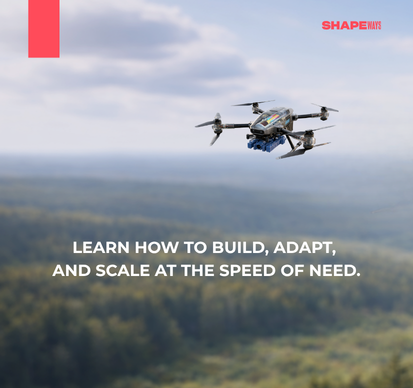
The defense landscape is evolving faster than ever, but the hardware behind it isn’t.
By 2026, the global drone market is projected to hit $13.73 billion. Autonomous systems, rapid deployment, and real-time intelligence are redefining modern operations. Yet there’s a critical mismatch: while software evolves in hours, hardware is still bound to manufacturing cycles measured in months.
That gap is no longer sustainable.
In our latest ebook, we explore how industrial additive manufacturing is reshaping defense innovation from material science to full-scale deployment. Here’s a preview of what’s inside.
Hardware Must Move at the Speed of Software
Traditional manufacturing introduces a structural risk: by the time parts are tooled, produced, and deployed, mission requirements may have already changed.
The shift underway is clear:
production must operate at the speed of engineering.
Industrial additive manufacturing enables:
- Faster lead times (from months to days)
- Lightweight, high-performance components
- On-demand production through digital inventory
The result? Hardware that is no longer static, but continuously evolving.
From Materials to Mission Readiness
In defense systems, materials don’t just support performance, they define it.
Instead of thinking in terms of “available materials,” leading teams now think in Material Readiness Levels:
- Can it withstand vibration, impact, and extreme environments?
- Will it perform consistently across thousands of units?
- Is it ready for deployment, not just prototyping?
Advanced polymers and metals now enable:
- Lighter airframes without sacrificing strength
- Greater durability in harsh conditions
- Complex geometries that improve both performance and efficiency
This isn’t just about better materials, it’s about mission-ready performance from day one.
Breaking the Prototyping Wall
One of the biggest constraints in defense innovation is what we call the “Prototyping Wall.”
Once a design moves to production, it gets locked in:
- Tooling is expensive and slow to change
- Supply chains require long-term forecasting
- Iteration becomes risky
The alternative? A digital supply chain.
By storing parts as digital files instead of physical inventory:
- Production becomes on-demand
- Updates can be deployed instantly
- Manufacturing can happen closer to the point of need
This creates a system that is not just efficient—but resilient by design.
Engineering for Tactical Advantage
When you remove manufacturing constraints, design fundamentally changes.
Instead of designing for tooling, engineers can design for performance:
- Consolidating multiple parts into one
- Embedding functionality directly into structures
- Optimizing geometry to reduce weight
In one example, rethinking drone geometry resulted in:
30% weight reduction → 30% increase in loitering time
That’s not incremental improvement, that’s operational advantage.
From Prototype to Fleet, Without the Delay
Innovation doesn’t fail at design. It fails at scale.
Traditional manufacturing slows down when moving from prototype to production:
- Tooling delays
- Locked designs
- Limited flexibility
Industrial additive manufacturing flips this model:
- Production starts immediately
- Designs evolve in real time
- Output scales with demand
This enables fleet readiness at the speed of need, without sacrificing consistency or quality.
A New Manufacturing Operating System
What’s emerging isn’t just a better way to produce parts—it’s a completely new model:
- Design becomes deployable in days
- Hardware improves with real-world feedback
- Supply chains shift from physical stock to digital readiness
This is what we call Digital Continuity, a seamless connection between design, production, and deployment.
Why This Matters Now
Defense is no longer limited by ideas. It’s limited by execution.
The competitive edge is shifting:
It’s not about who designs the best systems.
It’s about who can build, adapt, and scale them the fastest.
Get the Full Ebook
This is just a glimpse.
In the full ebook, we break down:
- How to implement Material Readiness in your workflow
- Real-world applications of digital supply chains
- The full framework for scaling from prototype to fleet
- And how industrial partners like Shapeways enable mission-ready production
👉 Download the full ebook to see how defense manufacturing is being redefined.