

Semi-flexible Thermoplastic Polyurethane (TPU95A), Shore 95A

TPU95A

Material Info

About

TPU95A is a semi-flexible thermoplastic polyurethane (TPU) material for FDM 3D printing, designed for parts that need a combination of flexibility, resilience, and durability. It is well suited for functional prototypes and end-use components that experience repeated bending, twisting, or impact, such as protective covers, flexible casings, seals, and similar wear-resistant parts.

With a Shore hardness of 95A and high elongation at break, TPU95A offers a strong balance between toughness and elasticity. This material is a good choice when you need more flexibility than rigid plastics while maintaining mechanical performance. PolyFlex™ TPU95 is described by the manufacturer as engineered to work on most desktop 3D printers.

Color & Finishes

White
Black
Custom
Contact Sales
Order minimum $300 per color.
Print Mode - Light
Prints with 0.8mm Shell thickness and 15% Infill
Print Mode - Medium
Prints with 1.2mm Shell thickness and 35% Infill
Print mode - Solid
Prints fully solid models

Material Properties

Density (ISO 1183, GB/T 1033)
1.20-1.24 g/cm³ at 23 °C
100% modulus (X-Y) (ISO 37, GB/T 528)
9.4 ± 0.3 MPa
Young's modulus (X-Y) (ISO 37, GB/T 528)
29 ± 2.8 MPa
Elongation at break (X-Y) (ISO 37, GB/T 528)
330.1 ± 14 %
Shore hardness (ISO 7619-1, GB/T 531.1)
95A

Description

Material Highlights
Semi-flexible TPU for durable parts requiring resilience, repeated bending, and impact tolerance
Flexibility & Elasticity
High elongation at break and Shore 95A hardness provide a balanced combination of toughness and flexibility
Abrasion Resistance
: Good wear resistance for parts exposed to repeated contact and handling

Design Guidelines

Bounding Box

Maximum Bounding Box
500x500x500 mm

Minimum Bounding Box
10 x 10 x 1 mm

The bounding box is a 3D imaginary outline of a box that encloses the smallest area occupied by your model. Your model must be within the minimum and maximum bounding box sizes. If the size of the model is close to the maximum bounding box, then the printing orientation will be restricted.

Walls

Supported Walls
0.8 mm
 
Unsupported Walls
1 mm

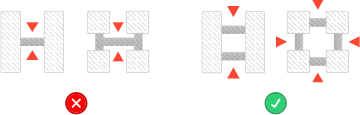
A supported wall is connected at least on two sides of the wall, while an unsupported wall is connected only on one side of the wall. Walls that do not meet the minimum requirements may not survive printing and cleaning processes. Additionally, models may still be rejected based on the wall geometry of the model. Please consider the size of your model and reinforce the walls or add support structures as needed as minimum guidelines will not always be adequate for large models.

Wires

Supported Wires

1.5 mm

Unsupported Wires

1.5 mm

A wire is a circular, rectangular or even triangular feature that is thinner in its unconnected directions than its length. A supported wire is connected at least on two sides of the model, while an unsupported wire is connected on one side of the model. Wires that do not meet the minimum requirements may not survive printing and cleaning processes. Additionally, models may still be rejected based on the wire geometry of the model. Please consider the size of your model and reinforce the wires or add support structures as needed as minimum guidelines will not always be adequate for large models.

Details

Embossed Details

0.2 mm

Engraved Details

0.2 mm

For text, the ratio between width and depth, should be 1:1 and sans-serif fonts are preferred for line weight consistency.

Clearance

Minimum

0.50 mm loose fit
0.40 mm normal fit
0.25 mm tight fit

Clearance is the space between two individual parts in a model. If the space among the individual parts do not meet the minimum clearance, then parts can fuse together or can be difficult to clean. This is important for movable pieces like hinges, gears, etc.

Sprues

Not Supported

Sprues are wires that keep two or more parts together. Parts should be connected with a minimum of two sprues each. Please consider the size of your sprues and increase them as needed as minimum guidelines will not always be adequate for large models. If the sprues are within the guidelines and are broken, but there is no damage to your model, we will still ship them as is.

Interlocking & Enclosed Parts

Interlocking
Supported

Enclosed
Not Supported

Multiple Parts

Not Supported

Accuracy


±0.5 mm, then ±0.2% of longest axis

Dimensional tolerance is ±0.5 mm plus ±0.2% of the longest axis. For example, a part measuring 50 x 50 x 100 mm may vary by ±(0.5 mm + 0.2 mm) = ±0.7 mm in any direction.

Stay up to date on promotions, case studies, and more.

Book a call with a specialist

"*" indicates required fields

Hidden
Hidden
Hidden
Hidden
Hidden
Hidden
Hidden
Hidden
Hidden
Hidden
Hidden
Hidden
This field is for validation purposes and should be left unchanged.