
Additive manufacturing has transformed how products are designed and produced. But moving from prototype to production requires more than just printing.
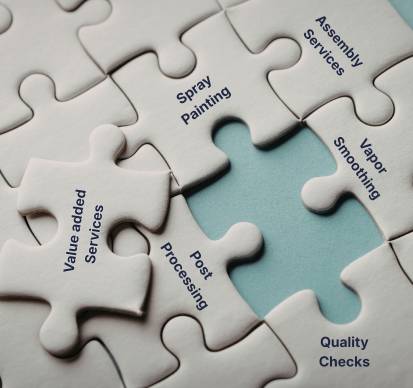
It requires post-processing in additive manufacturing, a set of value-added services that ensure parts meet functional, aesthetic, and quality requirements.
These services include:
- Custom quality checks
- Spray painting
- Vapor smoothing
- Assembly
Together, they turn printed parts into production-ready products.
What is Post-Processing in Additive Manufacturing?
Post-processing in additive manufacturing refers to all steps applied after 3D printing to improve a part’s performance, appearance, and usability.
These 3D printing finishing services are essential for:
- Achieving consistent quality
- Improving surface finish
- Ensuring functional performance
- Preparing parts for end-use applications
Without post-processing, most 3D printed parts remain limited to prototyping.
Why Post-Processing is critical for production-ready 3D printing
Many teams adopt additive manufacturing for its speed and design freedom. But when scaling to production, new challenges appear:
- Variability between parts
- Surface roughness and porosity
- Manual finishing bottlenecks
- Complex assembly workflows
This is why additive manufacturing post-processing becomes critical. It bridges the gap between:
- A printed part
- A finished, deployable product
The four essential value-added services in additive manufacturing
To move from prototyping to production, four key services play a central role:
1. Custom Quality Checks in additive manufacturing
Standard inspection methods are often not sufficient for additive manufacturing. Custom quality checks ensure that each part meets the specific functional and dimensional requirements of its application.
At Shapeways, quality workflows are tailored per part, enabling:
- Verification of critical dimensions
- Application-specific inspection criteria
- Consistency across production batches
👉 Learn more about custom quality checks
2. Spray Painting for 3D printed parts
Raw printed parts often lack the surface quality required for end-use products. Spray painting for 3D printed parts provides:
- Uniform color and texture
- Improved visual consistency
- A production-grade finish
This is essential for industries where appearance impacts product perception and usability.
👉 Explore spray painting capabilities
3. Vapor Smoothing in additive manufacturing
Parts produced with processes like SLS can have rough and porous surfaces. Vapor smoothing in 3D printing transforms these parts by:
- Creating smooth, sealed surfaces
- Reducing porosity
- Improving durability and cleanability
This makes parts suitable for demanding environments, including fluid systems and medical applications.
👉 Discover vapor smoothing
4. Assembly services in additive manufacturing
Producing parts is only one step. Additive manufacturing assembly services integrate:
- Printed and non-printed components
- Sub-assemblies
- Functional validation
This allows customers to receive ready-to-use products, not just individual parts.
👉 Learn more about assembly services
Reducing complexity with integrated manufacturing services
Each additional supplier in a manufacturing workflow introduces complexity:
- More logistics
- More coordination
- More risk
By combining 3D printing and post-processing services in one workflow, companies can:
- Reduce lead times
- Improve consistency
- Simplify supply chains
This is where additive manufacturing becomes scalable.
From printed parts to finished products
The biggest misconception in additive manufacturing is that printing is the final step. In reality, it is only the beginning.
The real value lies in:
- Finishing
- Validation
- Integration
This is what enables production-ready 3D printing.
Additive manufacturing doesn’t fail at the printer. It fails in the gap between printing and production.
Companies that scale successfully are not just investing in printing technology. They are investing in post-processing and value-added services that turn printed parts into finished products.
That shift, from printing parts to delivering complete solutions, is what defines the next phase of additive manufacturing.
Click here: Talk to our team about your application!