
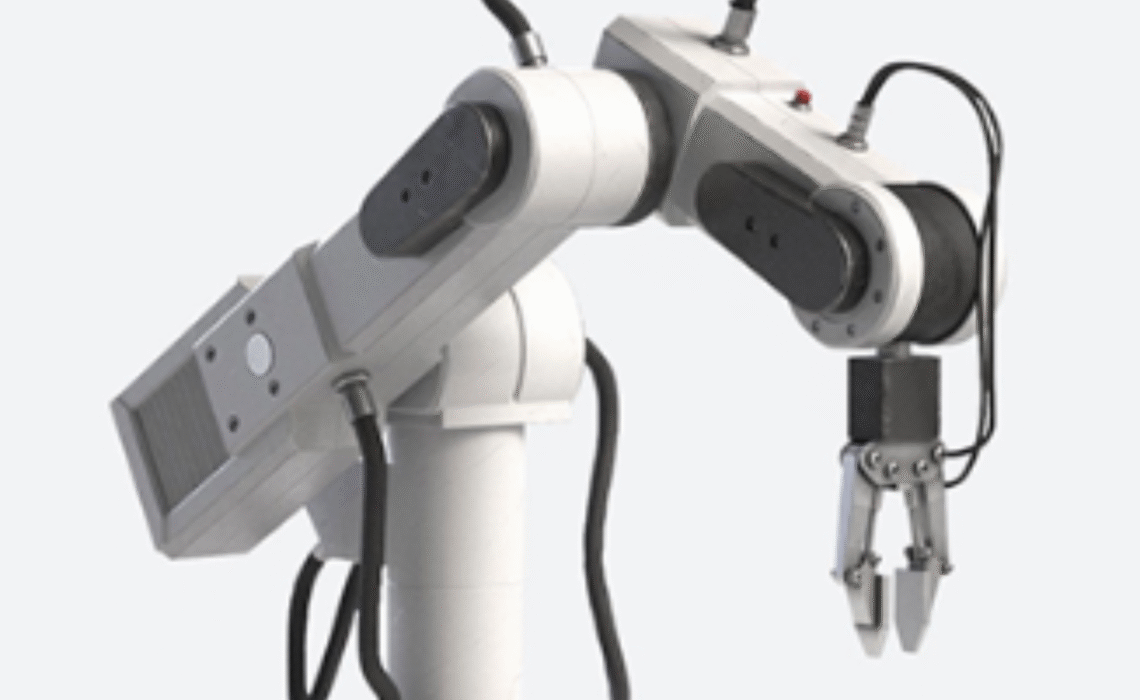
Robots are designed for flexibility. Their tooling often isn’t.
When a product changes, a new SKU is introduced, or a process needs to be optimized, end-of-arm tooling (EOAT) is frequently the first bottleneck. Traditional tooling can take weeks to design, manufacture, and deploy, slowing automation projects and increasing downtime.
Additive manufacturing offers a different approach.
By enabling custom tooling to be designed, tested, and produced in days rather than weeks, 3D printing helps manufacturers respond faster to changing production requirements while reducing tooling costs and complexity.
Why EOAT Matters
End-of-arm tooling is what allows a robot to perform a specific task.
Whether it’s a gripper handling delicate components, a fixture positioning parts for assembly, or a custom bracket supporting sensors and cameras, EOAT directly impacts productivity, accuracy, and reliability.
The challenge is that no two applications are exactly alike.
Different products require different gripping surfaces, different geometries, and different handling strategies. As production requirements evolve, tooling must evolve with them.
Traditional manufacturing struggles to support that level of flexibility.
The Advantages of 3D-Printed EOAT
For many robotic applications, the greatest value of additive manufacturing is speed.
Instead of waiting weeks for machined tooling, engineers can move directly from CAD to functional parts in a matter of days. Design revisions become simple. New tooling can be tested quickly. Production disruptions are minimized.
The benefits extend beyond lead times:
- Faster customization for unique part geometries
- Cost-effective production of low-volume tooling
- Reduced downtime through rapid replacement parts
- Easier design updates without scrapping existing tooling
- Greater flexibility for changing products and processes
Most importantly, additive manufacturing enables tooling to evolve as quickly as production requirements change.
Custom Grippers Built for the Application
Grippers are among the most common applications for additive manufacturing.
Standard grippers often require compromises when handling complex or delicate parts. With 3D printing, engineers can create gripping surfaces tailored to the exact geometry of the component being handled.
This improves reliability, reduces part damage, and enables automation of tasks that would otherwise be difficult to automate.
Lightweight polymer designs can also reduce overall end-effector weight, improving robot performance and reducing mechanical strain on the system.
Smarter Fixtures and Workholding
Fixtures are essential for maintaining accuracy during assembly, inspection, welding, and finishing operations.
Because fixtures are highly specific to the part they support, even small product changes can require new tooling. Traditional manufacturing makes these updates expensive and time-consuming.
Additive manufacturing allows manufacturers to create dedicated fixtures for specific products without significant upfront investment. Digital files can be updated quickly, enabling fixtures to evolve alongside the products they support.
The result is a more agile production environment capable of adapting to changing customer requirements.
Turning Tooling into a Competitive Advantage
The value of robotic automation is no longer measured solely by robot performance.
It is increasingly measured by how quickly production systems can adapt.
3D-printed EOAT helps manufacturers reduce downtime, accelerate changeovers, and deploy automation faster. By removing the constraints of traditional tooling, companies gain the flexibility needed to support high-mix production environments and evolving product requirements.
The result is not just better tooling.
It is more agile manufacturing.
Build Custom EOAT Faster
Whether you’re designing a new gripper, fixture, or robotic assembly, Shapeways can help you move from CAD to production-ready tooling in days, not weeks.
Talk to our team about your EOAT project
Guides and Material Handling Components
Guides direct parts along conveyor systems, into chutes, or through assembly stations. Like fixtures, they are highly specific to the part and process. Even minor changes to part dimensions can render existing guides unusable.
3D printing allows guides to be produced in small batches and updated quickly when product designs change. Complex internal geometries, curved channels, multi-direction deflectors, angled entry points, that would be expensive to machine are straightforward to produce additively.
For high-mix, low-volume production environments, having the ability to print replacement or updated guides within hours keeps lines moving without lengthy retooling cycles.
Robotic Tooling and Sensor Mounts
Beyond grippers and fixtures, robotic arms often carry cameras, force-torque sensors, vacuum systems, or ultrasonic tools. Mounting these components precisely, and integrating them cleanly into the arm’s geometry, requires custom brackets and housings.
3D printing allows these mounts to be designed with cable routing channels, snap-fit sensor pockets, and exact bolt patterns built in. The result is cleaner integration and faster installation compared to fabricated sheet metal solutions. When a sensor model changes or an arm is reconfigured, the mount file is updated and reprinted. No new vendor quotes. No weeks of waiting.
Integrating 3D-Printed Tooling into Your Automation Workflow
Bringing additive manufacturing into your EOAT process does not require rebuilding your engineering workflow. Most teams can integrate it by following a few practical steps:
- Identify high-turnover tooling: Start with the fixtures, grippers, or guides that change most frequently or have the longest lead times when replaced.
- Build a digital file library: Maintain CAD files for all current tooling. Version control ensures teams are always working from the latest design.
- Pilot with low-risk applications: Use 3D printing first for secondary fixtures or non-critical guides before applying it to primary production tooling.
- Validate material performance: Run short production cycles with printed parts before committing them to full production duty.
- Partner strategically: Whether you print in-house or use a service provider, ensure you have consistent access to the materials and process quality you need.
The goal is not to replace all machined tooling with printed parts. It is to use 3D printing where it provides a clear advantage, fast iteration, low-volume flexibility, and on-demand replacement.
Tooling Flexibility Is a Manufacturing Advantage
The pace of product change and automation deployment in modern manufacturing puts pressure on every part of the engineering process, including the tooling that makes robots work. Custom EOAT built with 3D printing gives manufacturers a way to keep up.
Do you require support? Get in contact with out team