
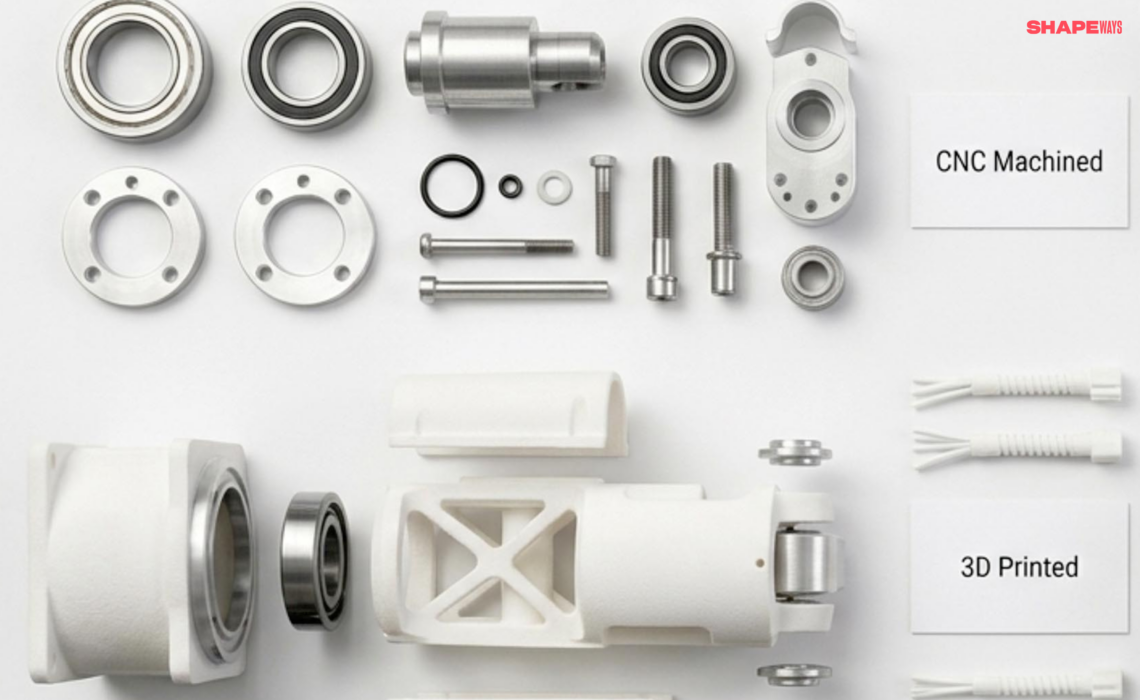
One of the most important manufacturing decisions in robotics isn’t choosing the right material or design. It’s choosing the right production process.
For robotics companies, the choice often comes down to two technologies: additive manufacturing (AM), and CNC machining. Understanding additive manufacturing vs CNC machining in robotics can help engineers choose the right process for each component.
Each has its strengths. AM offers speed and design freedom. CNC machining delivers precision and a wide range of engineering materials.
The challenge isn’t deciding which technology is best.
It’s knowing when to use each one.
Why Manufacturing Process Matters in Robotics
Robotics components often require complex geometries, lightweight structures, tight tolerances, and reliable mechanical performance. At the same time, production volumes can vary significantly.
A custom gripper may only require a few parts. A precision robotic joint may need CNC machining for tight tolerances. A robotic housing entering mass production may require thousands of identical parts.
That means the right manufacturing process depends on more than cost. Volume, tolerances, materials, complexity, customization, lead time, and design stability all play a role.
When to Use Additive Manufacturing
Additive manufacturing is ideal when speed, flexibility, and design complexity are priorities.
Because parts can be produced directly from digital designs without dedicated tooling, engineers can move quickly from CAD to physical components. Design changes are also relatively easy to implement, making AM particularly valuable during product development.
AM is commonly used for:
- Functional prototypes
- Custom end-of-arm tooling (EOAT)
- Sensor mounts and brackets
- Lightweight components
- Low-volume production
- Spare and replacement parts
- Complex geometries
One of AM’s biggest advantages is design freedom. Internal channels, lattice structures, organic geometries, and part consolidation can often be produced without the tooling constraints associated with injection molding or the tool-access limitations of CNC machining.
Choose AM when flexibility and fast iteration matter more than minimizing cost at high volumes.
When to Use CNC Machining
CNC machining is a strong choice when precision, material performance, and dimensional accuracy are critical.
It removes material from a solid block using precision cutting tools, allowing manufacturers to produce parts from materials such as aluminum, stainless steel, steel, brass, and engineering plastics.
CNC machining is commonly used for:
- Robotic joints
- Precision mounts and brackets
- Motor and gearbox components
- Structural components
- Precision EOAT
- Fixtures and tooling
- Low- to medium-volume production
CNC is particularly useful for components that interface with bearings, shafts, motors, sensors, or other precision components.
The trade-off is that CNC machining generally becomes less economical at very high volumes, and certain complex internal geometries can be difficult to produce.
Choose CNC when tight tolerances, material selection, and mechanical performance are the priority.
Additive Manufacturing vs. CNC Machining in Robotics
| Factor | AM | CNC Machining |
| Best For | Complex, customized parts | Precision components |
| Production Volume | Low to medium | Low to medium |
| Tooling | None | None |
| Design Changes | Easy | Relatively easy |
| Tolerances | Technology-dependent | Excellent |
| Material Options | Technology-dependent | Broad |
| Customization | Excellent | Good |
| Cost at High Volume | Higher | Higher |
Which Process Should Robotics Companies Choose?
There is no universal winner.
Choose AM when you need rapid iteration, customization, or complex geometries.
Choose CNC when you need precision, engineering-grade materials, or tight mechanical interfaces.
And sometimes, the best answer is to use more than one.
A robotics company might use AM for early prototypes, and CNC for precision components. The right combination depends on the requirements of each individual part.
The Right Process for the Right Robotic Component
The question isn’t which manufacturing technology is better.
It’s which technology is best for this part, at this volume, with these requirements?
Additive manufacturing provides flexibility. CNC machining provides precision. By choosing the right process for each application, robotics companies can move faster, control costs, and build better products.
From Prototype to Production
Shapeways combines additive manufacturing, and CNC machining to support robotics companies from early prototypes and custom EOAT to precision components and production-scale manufacturing.
Talk to our team about your robotics manufacturing requirements.