
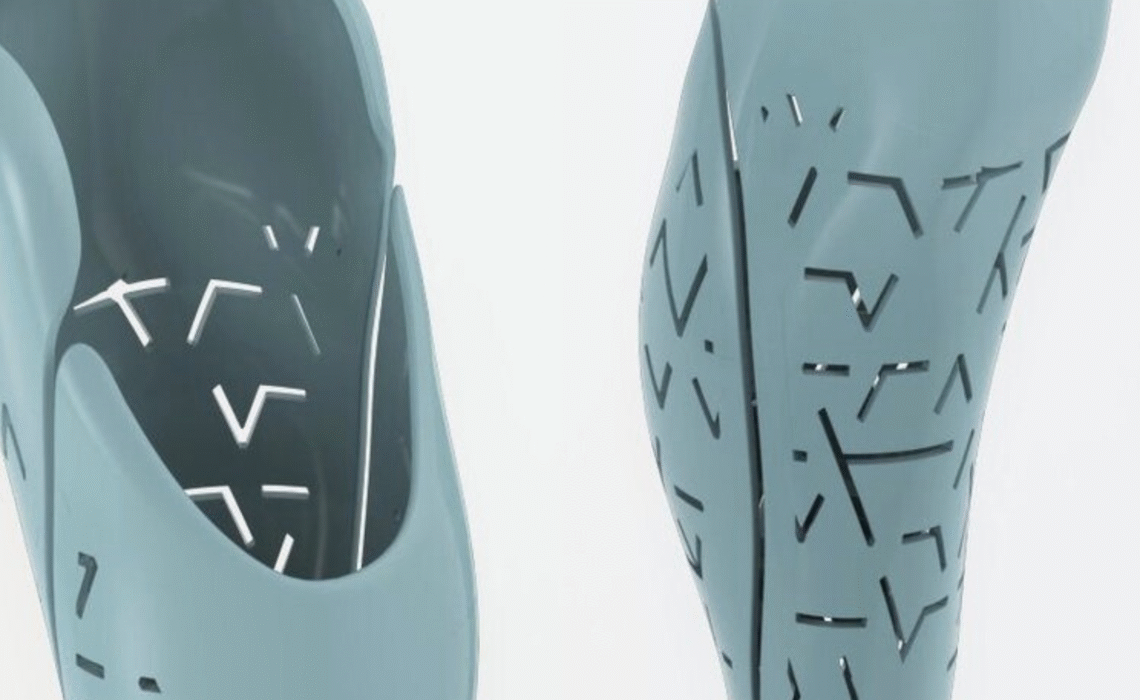
In orthotics and prosthetics (O&P), precision is not a luxury, it is a requirement. 3D printing in orthotics and prosthetics is transforming how devices are designed and manufactured, enabling more accurate, patient-specific solutions than traditional methods. Yet for decades, much of the industry has relied on standardized manufacturing methods that struggle to reflect the complexity of individual patients.
Additive manufacturing is changing that equation.
By combining digital scanning, advanced design software, and industrial 3D printing, orthotic and prosthetic workflows are becoming faster, more precise, and fundamentally more patient-centric. What was once a manual, iterative process is now evolving into a digital pipeline, where patient data can be translated directly into functional, production-ready devices.
From manual processes to digital workflows in 3D printing orthotics and prosthetics
The change begins with data. High-resolution 3D scans capture the exact anatomy of a patient, enabling clinicians and designers to move beyond approximations. Instead of modifying generic molds, teams can use patient data to create precise designs.
This digital approach significantly reduces fitting iterations. Clinicians and designers can create ankle-foot orthoses, custom insoles, and prosthetic interfaces with a level of precision that improves both clinical outcomes and patient comfort. Just as importantly, teams can store, adjust, and reproduce these designs, creating a more scalable model for personalized care.
Bridging customization and production at scale
A major advantage of 3D printing in orthotics and prosthetics is the ability to scale customization.
Using industrial technologies such as selective laser sintering, manufacturers can produce complex geometries without tooling, while maintaining consistency across batches. Materials like Nylon PA11 and PA12 offer the durability, flexibility, and biocompatibility required for real-world orthotic and prosthetic applications. Manufacturers already use these materials in market-ready products.
For O&P providers and manufacturers, this opens a new operational model. Instead of choosing between handcrafted customization and mass production, it becomes possible to deliver patient-specific devices with repeatable quality, shorter lead times, and reduced material waste
Where Shapeways fits in the O&P ecosystem
This is where Shapeways plays a distinct role.
Shapeways supports orthotics and prosthetics companies in moving from concept to production with industrial-grade additive manufacturing. The focus is not only on prototyping, but on enabling reliable, low-volume production at scale. This includes access to proven materials, strict quality controls, and post-processing capabilities that ensure parts are ready for real-world use.
For companies developing custom orthotic devices or prosthetic components, this means faster iteration cycles during development, and a smoother transition into production once designs are validated. It also allows teams to respond more quickly to patient needs without building complex in-house manufacturing infrastructure.
Improving outcomes for patients and clinicians
The impact is tangible. Better fit leads to improved patient compliance. Lighter, optimized structures enhance mobility and comfort. Faster production reduces waiting times, which can be critical in rehabilitation and recovery.
For clinicians, the ability to rely on digital workflows reduces manual workload and increases consistency. For businesses, it creates opportunities to scale personalized products without compromising on quality.This is not a future scenario. It is already happening across the O&P landscape.
Shapeways demonstrates how end-to-end digital workflows, from 3D scanning to final production, can be implemented in practice. Set a meeting and explore real applications, materials, and production approaches that enable scalable customization without sacrificing performance or reliability. You can contact our team for support here.
We will be at OTWorld this May to discuss how digital manufacturing accelerates medical development.
If you are attending, let’s connect.