
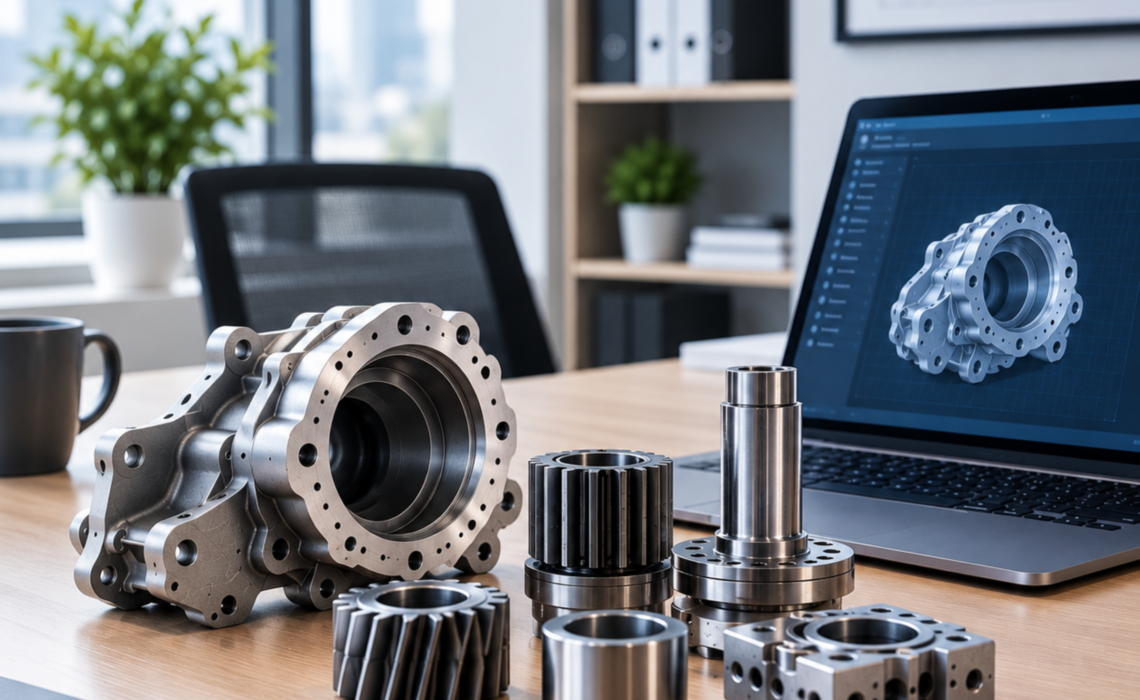
Defense spare parts are becoming harder to source as platforms are built to operate for decades. The supply chains supporting them often are not.
A digital-first defense spare parts strategy offers another approach. By combining digital inventories with on-demand manufacturing, defense organizations can move from storing every possible replacement part to maintaining the capability to produce parts when they are actually needed.
What’s wrong with traditional Defense spare parts logistics?
Military equipment frequently remains in service for thirty, forty, or even fifty years. The suppliers and manufacturing processes behind individual components rarely follow the same timeline.
During the lifetime of a platform, original manufacturers may stop producing a component, suppliers may leave the market, tooling may be scrapped, or minimum order quantities may make replacement parts commercially unrealistic.
Traditional spare parts strategies attempt to compensate for this uncertainty through physical inventory. Organizations purchase and store components in anticipation of future demand, sometimes years or decades before those parts may actually be required.
The problem is that predicting future failures is difficult.
Some components may never be used, while an unexpected failure of a different part can leave equipment waiting for a replacement no longer readily available. At that point, restarting traditional production can require new tooling, new suppliers, engineering work and qualification turning what appears to be a simple spare part into a significant supply chain challenge.
How do digital inventories change Defense spare parts management?
A digital inventory changes what an organization needs to keep in stock.
Instead of storing every physical component, selected parts can be maintained as controlled, production-ready digital files, together with the manufacturing information required to reproduce them.
When demand occurs, the part can be manufactured rather than retrieved from a warehouse.
For defense organizations, this creates a more flexible model for lifecycle support. Physical inventory can still be maintained where it makes operational sense, while suitable long-tail, low-demand, or obsolete components can move toward a digital inventory model.
The objective is not to eliminate warehouses entirely. It is to become more deliberate about what needs to exist physically and digitally until the moment it is required.
What role does on-demand manufacturing play in Defense readiness?
A digital inventory only creates value when there is manufacturing capability behind it.
On-demand manufacturing connects the digital file with production. Technologies such as additive manufacturing and CNC machining make it possible to produce individual parts or small batches without maintaining a dedicated production line for every component.
This is especially relevant for defense spare parts, where demand is often irregular and volumes are relatively low.
A maintenance organization may need three brackets rather than three thousand. A vessel may require one replacement housing. An older system may need a component that has not been produced for fifteen years.
In those situations, the ability to manufacture according to actual demand can be significantly more practical than rebuilding an entire traditional supply chain around a very small number of parts.
At Shapeways, digital manufacturing workflows connect engineering data with a broad range of production technologies and materials, helping customers move from digital designs to manufactured components without having to create and manage dedicated production infrastructure themselves.
How does obsolescence threaten legacy Defense platforms?
Obsolescence is one of the most persistent challenges in long-lifecycle defense programs.
A platform can remain operational long after the commercial lifecycle of many of its components has ended. When an original supplier discontinues a part or leaves the market entirely, responsibility for solving that problem moves downstream to the organization maintaining the platform.
This can lead to costly redesigns, last-time buys, cannibalization of existing equipment, or attempts to restart production processes that disappeared years earlier.
Digital manufacturing creates another option.
Where technically appropriate and permitted by the relevant qualification requirements, engineering teams can reverse-engineer legacy components, redesigned for modern manufacturing processes and converted into controlled digital production files.
That does not remove the need for engineering validation or qualification. What it can do is provide a more sustainable route to maintaining access to parts whose original supply chains no longer exist.
Why does low-volume production matter for Defense spare parts?
Many defense spare parts have exactly the characteristics traditional manufacturing handles least efficiently: low volumes, unpredictable demand and long periods between orders.
Conventional manufacturing processes often depend on tooling, minimum order quantities and production economics designed around larger batches. When only a handful of parts are required, the cost and lead time of restarting production can become disproportionate to the value of the component itself.
Digital manufacturing works particularly well for these situations.
Additive manufacturing can eliminate tooling for suitable components, while modern CNC manufacturing can support smaller production runs without requiring customers to maintain their own dedicated production capacity.
This makes it possible to produce closer to demand rather than manufacturing large quantities simply to make the economics of production work.
How can replacement parts reach operations faster?
When a critical component fails, the real problem is rarely the value of the part itself. It is the impact of the equipment being unavailable.
Reducing the number of steps between identifying the need and producing the replacement is therefore a key part of improving readiness.
Digital files can remove several stages from the traditional procurement process. Instead of searching for an obsolete supplier, rebuilding tooling or negotiating production of a small batch within a supply chain optimized for mass manufacturing, organizations can move directly toward an approved manufacturing route.
Depending on the component, manufacturing process, qualification requirements and production location, this can significantly reduce the time required to obtain replacement parts.
Why does distributed manufacturing improve supply chain resilience?
Recent supply chain disruptions have also highlighted the risks of concentrating production in a small number of suppliers or locations.
When manufacturing depends on one factory, one tool or one supplier, disruption at that point can affect the entire supply chain.
Digital manufacturing allows the separation of production data from a single production location.
With the appropriate process controls, qualification framework and manufacturing network, a digital part can potentially be produced across different qualified locations. This gives defense organizations greater flexibility to respond to capacity constraints, geopolitical disruption or urgent requirements.
For European defense organizations, that capability can also support broader objectives around supply chain resilience, regional manufacturing capacity and industrial sovereignty.
What does this mean for lifecycle support?
Platforms designed to remain operational for decades need a spare parts strategy capable of surviving the same timeframe.
Defense organizations will continue to play an important role, particularly for frequently used or mission-critical components. But attempting to predict every future spare parts requirement and store every possible component for decades is neither financially nor operationally sustainable.
Digital inventories create another layer within the spare parts strategy.
They allow organizations to identify suitable components, capture the manufacturing knowledge behind them, and preserve the ability to produce those parts long after the original supply chain has disappeared.
Combined with on-demand manufacturing, this can help extend the useful life of existing platforms while reducing dependency on aging tooling, discontinued suppliers and oversized physical stockpiles.
From spare parts inventory to manufacturing readiness
The future of defense logistics will not be defined only by how many spare parts an organization has on a shelf.
Increasingly, readiness depends on how quickly an organization can recreate what is missing.
That requires more than simply installing 3D printers. It requires identifying the right components, creating controlled digital inventories, selecting appropriate manufacturing technologies, establishing qualification processes and connecting those digital assets to reliable production capacity.
For defense organizations managing aging fleets, and increasingly uncertain supply chains, developing that capability now can create significantly more flexibility in the years ahead.
The goal is not to replace every traditional supply chain.
It is to ensure that when the traditional supply chain no longer works, there is another way to manufacture the part.
Meet Shapeways at NEDS 2026
Shapeways will be at NEDS 2026 on 19 November, bringing together government, industry and knowledge institutes from across the defense and security ecosystem.
If you are attending, our team would be happy to discuss how digital inventory, additive manufacturing, CNC machining and on-demand production can support long-term defense readiness and lifecycle management.
Book a meeting with our team
You can also explore the Shapeways Defense Program and learn more about how we support the industry.