
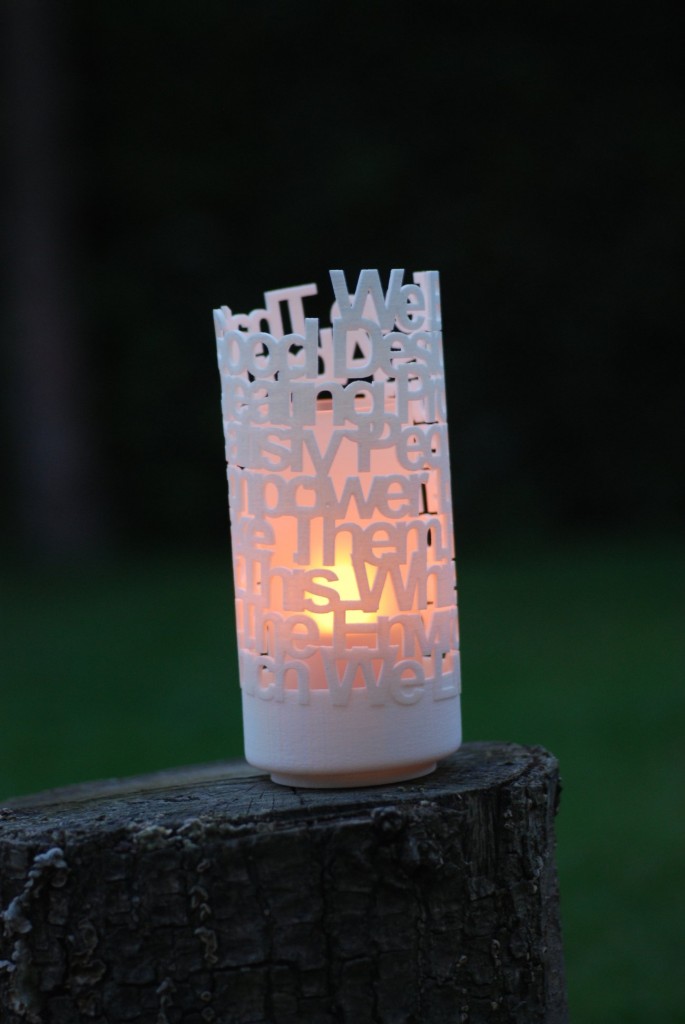
The first wave of democratization in additive manufacturing was about giving more people access to additive manufacturing technologies. When Shapeways went online in 2008, it gave anyone the ability to 3D print quality parts without owning a machine or learning CAD. From light poems and gyroids to bottle openers and abstract art, it changed how people perceived their role as makers.
The early community started to prove that this new access model could drive manufacturing too. Now, fifteen years on, the next phase of democratization is less about giving people access to printers, and more about giving businesses access to a new means of production.
“Back then our mission was to give consumers access to industrial-grade additive manufacturing,” says our COO, Jules Witte. “Over time, the technology developed as did our expertise and we proved that we could meet the expectations of serious B2B manufacturing programs.”
Through Thangs we are still empowering creatives and makers, and constantly encouraging more people to design and make.
From access to assurance
In the first wave of democratization we worked at lowering barriers; the second phase is about raising confidence. Today’s innovators, be they start-ups, design houses, even established manufacturers, want the freedom of additive manufacturing without inheriting its complexity. They need to trust the output, understand the economics and integrate parts directly into their production.
Shapeways’ role in that shift has been to translate accessibility into reliability. “If we want to continue to scale additive manufacturing, we need to show we can deliver consistent quality within the boundaries our customers set. That’s what we’re building,” says Jules.
By managing most production internally, we keep direct control of process stability and quality, offering the assurance that digital manufacturing can meet industrial expectations — at scale.
Digital infrastructure for a new generation
For additive manufacturing, democratization 2.0 is just as much a technical question as a philosophical one. What once required manual quotes and slow back-and-forth now happens instantly. Upload a file, get a price, receive a production-ready part in days.
“We were the first to offer instant online quoting at scale,” Jules recalls. “That digital access was a paradigm shift that removed the friction that stopped so many good ideas from going anywhere.”
That frictionless model is what allows next-generation hardware companies to move fast. A small team with an idea for a connected product can go from concept to proof of principle in weeks. By using desktop printers for first-pass prototyping and leveraging complementary or alternative production methods like CNC machining and vacuum forming, teams can design anywhere and manufacture everywhere.
The same digital infrastructure that enable AM can also be used to broaden the vision for manufacturing democratization. Whether a part needs to be 3D printed, machined or formed it should make it effortless to choose the right path and get it made.
The economics of access
Economics plays a huge role too. Jules points to the steady uptake of more sustainable materials like PA11, which give users flexibility with bio-based sourcing but have yet to replace workhorses like PA12.
“There are definitely niches where new materials find a home,” he says. “But adoption is slower because customers need reliability and cost advantage first. It’s an understandable effect of the maturity of the process.”
That realism is now defining AM after years of razzmatazz and allowing greater parity of acceptance with more established manufacturing technologies. Ensuring that advanced technologies — whether additive, subtractive, or forming — are commercially viable so more companies can depend on them every day is key to giving greater access.
What comes next
As software-led hardware startups multiply, success will depend on partnership between service providers, hardware OEMsn and material suppliers to keep complexity hidden and outcomes consistent.
“The winners will be the ones who make it simple for new hardware teams to try, learn and scale,” Jules says.
It’s easy to get addicted to novelty, but the new phase of democratization shows that consistency, interoperability, and trust are the foundations for the next chapter. The future won’t belong to one technology but it will belong to the platforms that bring them all within easy reach.