
Additive manufacturing has moved well beyond its role as a prototyping technology. The question for manufacturers today is no longer whether AM belongs in industrial production, but where it creates the most value and how it can work alongside the broader manufacturing technologies needed to bring products to market.
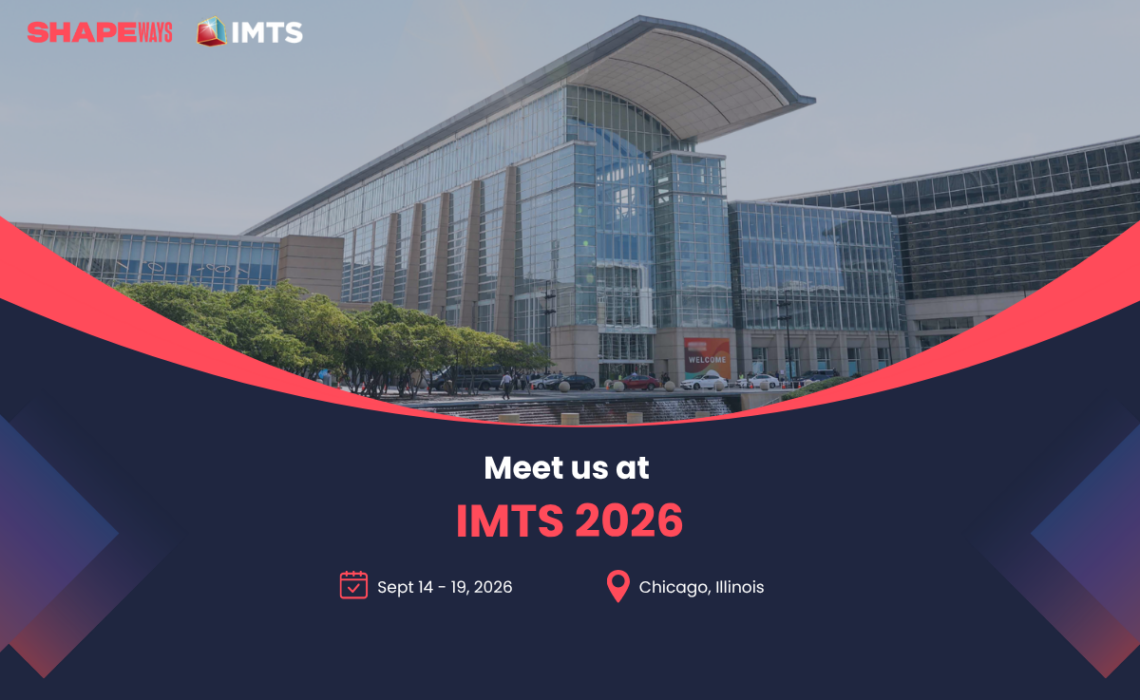
These questions will be part of the conversation at IMTS 2026 in Chicago, where manufacturing leaders, engineers, and technology providers will explore the technologies shaping the next generation of production.
For Robert Schouwenburg, CTO of Shapeways, who will attend IMTS this September, this intersection between digital technology and physical manufacturing is particularly relevant. As manufacturing becomes increasingly software-driven, the opportunity is not simply to improve individual production technologies, but also to connect them into smarter and more flexible manufacturing systems.
Additive Manufacturing Has Become Part of a Much Bigger Shift
Additive manufacturing expanded what manufacturers could do.
Complex geometries became easier to produce. Tooling requirements could be reduced or eliminated. Short production runs became more economical. Designs could move from digital files to physical parts much faster.
But the evolution of AM is now happening within a much broader transformation of manufacturing.
Software, automation, robotics, AI, advanced materials, CNC machining, additive manufacturing, and increasingly sophisticated quality systems are converging. The result is a manufacturing environment where the question becomes less about which technology wins and more about which combination of technologies is right for a specific part, application, and production requirement.
That distinction matters.
For industries such as aerospace, defense, medical technology, robotics, and industrial equipment, flexibility is becoming increasingly valuable. Manufacturers need to move quickly from development to production, while maintaining control over quality, cost, lead time, and supply-chain risk.
AM can be a powerful part of that equation — but it is rarely the entire equation.
From Prototyping to Low-Volume Production
One of the clearest examples of how manufacturing is evolving is the shift from design toward flexible, low-volume production.
Shapeways helps companies move beyond the design by providing on-demand and production of end-use parts using production-grade materials and scalable digital manufacturing technologies together with finished product services like spray painting, assembly and others. By connecting the digital design directly to manufacturing, companies can move from file to finished part without the upfront investment, long lead times, and complexity traditionally associated with tooling and fragmented supply chains.
This model is particularly valuable when demand is uncertain, products are still evolving, or applications require high customization. Instead of committing too early to large production runs, companies can manufacture what they need when they need it, while retaining the flexibility to improve the product as requirements change.
The value becomes clear across different industries. A medical technology company, for example, may need to validate and refine a specialized device through several design iterations before moving into production. Digital manufacturing allows those iterations to happen while maintaining a clear path toward producing functional, end-use parts.
A drone or robotics manufacturer may face a different challenge: producing lightweight, geometrically complex components while demand is still difficult to predict. With digital manufacturing, the company can continue to optimize component designs and produce low volumes without committing to expensive tooling or large inventories.
In both cases, the advantage is not simply faster prototyping. It is the ability to bridge development and production with a manufacturing model that can adapt as the product, demand, and business evolve.
Software Is Becoming Part of the Factory Floor
One of the most significant changes in manufacturing is beyond the machines themselves.
Software increasingly determines how efficiently those machines can be used.
Automation and artificial intelligence improve how manufacturers evaluate designs, plan production, optimize processes, predict performance, and manage quality. Robotics can reduce manual handling between production stages, while connected manufacturing systems can provide greater visibility into what is happening across the production process.
For additive manufacturing, these capabilities can mean faster iteration, more consistent production, and tighter integration with downstream processes.
But the larger opportunity goes beyond optimizing AM.
As manufacturing becomes more digital, software can increasingly help determine how a part should be manufactured, considering geometry, material, quantity, tolerances, lead time, cost, and other requirements, before directing production toward the most appropriate process.
This is where digital manufacturing becomes particularly powerful.
Industrial Production Requires More Than a Machine
Scaling any manufacturing technology from individual parts to reliable production requires more than the ability to make the part.
Production requires repeatability.
It requires material consistency, process control, inspection, traceability, and quality systems capable of delivering the same result again and again.
This becomes especially important in industries such as medical, aerospace, and defense, where manufacturers need more than a successful production run. They need confidence in the process behind it — and the data to support that confidence.
The same principle applies whether a component is produced through additive manufacturing, CNC machining, injection molding, or another process.
Ultimately, industrial customers are not buying manufacturing technology.
They are buying a reliable part.
From Individual Technologies to a Flexible Manufacturing Ecosystem
The next generation of industrial manufacturing will not be defined by a single process.
Additive manufacturing will continue to provide significant advantages for applications involving complex geometries, customization, rapid iteration, and certain production volumes. CNC machining will remain critical when precision, materials, tolerances, or production requirements make subtractive manufacturing the better choice. Other processes will continue to solve other manufacturing challenges.
The opportunity lies in connecting these capabilities.
Imagine a manufacturing environment where a digital system can evaluate a part, understand its requirements, determine the most appropriate production technology, route it to the right manufacturing capacity, and maintain visibility throughout production and fulfillment.
That is a very different model from simply ordering a 3D-printed or CNC-machined part.
It is a digital manufacturing ecosystem built around the requirements of the product, rather than the limitations of a particular production technology.
And it is one of the reasons events such as IMTS matter. They bring together technologies often discussed separately — machines, software, automation, robotics, inspection, additive manufacturing, and traditional manufacturing — but increasingly need to work as one connected system.
Shapeways at IMTS 2026
This is the perspective Shapeways CTO and co-founder Robert Schouwenburg will bring to IMTS 2026.
For Shapeways, the evolution from additive manufacturing toward broader digital manufacturing reflects what industrial customers increasingly need: access to the right manufacturing technology, combined with the software, quality systems, and operational infrastructure required to move efficiently from design to production.
Our goal is not to advocate for additive manufacturing in every application.
It is to help manufacturers determine where AM makes sense, where another technology makes more sense, and how those capabilities can work together within a more flexible production strategy.
If you’re attending IMTS 2026 in Chicago this September, Robert will be there to meet with manufacturers, technology partners, and industry leaders exploring these same questions.
Want to discuss where digital manufacturing fits within your production strategy? Book a meeting with Robert at IMTS 2026.