
Medical device development is moving faster than traditional manufacturing was designed to support.
Medical device companies, orthopedic innovators, and healthcare technology providers are under growing pressure to shorten development cycles, respond to clinician feedback more quickly, and deliver products that meet increasingly personalized patient needs. At the same time, they must navigate cost pressures, inventory challenges, and complex product development requirements.
Traditional manufacturing methods often struggle to keep pace. Tooling investments, long lead times, and production constraints can slow innovation at precisely the moment when agility matters most.
Digital manufacturing offers a different path.
By combining advanced additive manufacturing with on-demand production, companies can move more efficiently from concept to commercialization, reducing development risk while increasing flexibility throughout the product lifecycle.
The Shift Toward Digital Medical Product Development
Historically, medical product development followed a predictable path. Engineers designed a product, prototypes were produced and tested, tooling was created, and manufacturing scaled once designs were finalized.
Today, that linear approach is becoming less practical.
Medical products are increasingly specialized. Clinicians expect products that better fit patient needs. Development teams require more frequent design iterations. Healthcare providers want solutions that can evolve alongside changing requirements.
Digital manufacturing supports this shift by enabling companies to move directly from digital design files to physical parts without relying on traditional tooling.
This creates a more agile development process where teams can test, refine, and improve products faster while maintaining greater control over costs and timelines.
Accelerating Medical Device Development
Speed remains one of the most significant advantages of digital manufacturing.
In traditional manufacturing environments, design changes often trigger delays caused by tooling modifications, supplier lead times, or production setup requirements. These delays can slow product validation, stakeholder reviews, and regulatory preparation.
With additive manufacturing, design teams can rapidly transform CAD models into functional parts for evaluation and testing.
This enables organizations to:
- Evaluate multiple design concepts simultaneously
- Refine ergonomics and usability earlier in development
- Validate assemblies before committing to production investments
- Incorporate clinician and customer feedback faster
- Reduce time between design iterations
The result is a more efficient development cycle that helps teams identify issues earlier and make more informed decisions throughout the product development process.
Enabling Patient-Specific Healthcare Solutions
One of the most transformative aspects of digital manufacturing is its ability to support personalization at scale.
Healthcare is increasingly moving toward patient-specific solutions, particularly within orthopedics, rehabilitation, and wearable medical technologies. Traditional manufacturing often requires companies to choose between customization and efficiency.
Digital manufacturing removes much of that trade-off.
Because products are manufactured directly from digital files, individual designs can be modified without requiring new tooling or complex production changes.
This approach is particularly valuable for:
- Orthoses and orthopedic braces
- Prosthetic components
- Rehabilitation and mobility devices
- Hearing-related products
- Wearable healthcare technologies
- Patient-specific medical device interfaces
- Anatomical and surgical planning models
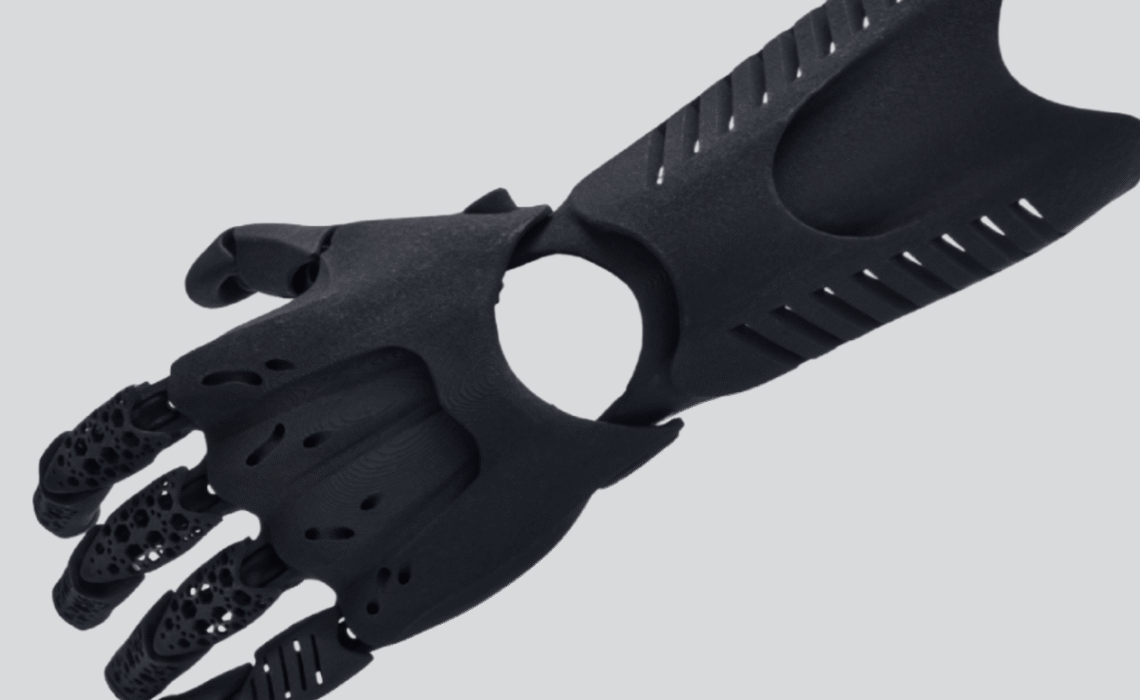
For orthopedic innovators, additive manufacturing also enables design features that would be difficult or impossible to produce using conventional methods. Lightweight lattice structures, optimized ventilation, and patient-specific geometries can improve comfort, fit, and overall user experience while maintaining manufacturing efficiency.
Bridging the Gap Between Prototyping and Production
Many organizations initially adopt additive manufacturing for prototyping. Increasingly, however, they are discovering its value throughout the entire product lifecycle.
Digital manufacturing allows companies to bridge the gap between product development and full-scale production.
Rather than investing immediately in expensive tooling, organizations can produce low-volume runs for clinical evaluation, pilot programs, market testing, or early commercial deployment. This approach helps reduce financial risk while generating valuable real-world feedback.
For medical companies developing specialized products or serving niche patient populations, this flexibility can provide a significant competitive advantage.
Building More Resilient Healthcare Supply Chains
Medical manufacturers are also reevaluating how products are produced, stored, and delivered.
Traditional supply chains often rely on large production runs and inventory storage, creating challenges when demand fluctuates or products require frequent updates.
Digital manufacturing supports a more responsive model.
Parts can be produced on demand, reducing inventory requirements while enabling companies to manufacture only what is needed when it is needed. This can help reduce waste, improve responsiveness, and support more efficient product lifecycle management.
For organizations managing low-volume products, replacement components, or highly specialized medical devices, on-demand manufacturing offers a practical alternative to traditional inventory-heavy approaches.
The Future of Medical Manufacturing
The future of medical manufacturing is becoming increasingly digital, personalized, and agile.
Medical innovators are no longer evaluating additive manufacturing solely as a prototyping technology. They are integrating digital manufacturing into product development, personalization strategies, bridge manufacturing programs, and production workflows.
Organizations that embrace these capabilities are better positioned to accelerate innovation, respond to changing healthcare needs, and bring new products to market with greater confidence.
At Shapeways, we help medical device companies, orthopedic innovators, and healthcare technology providers move from concept to production through advanced additive manufacturing and digital manufacturing solutions.
Whether you are developing patient-specific products, validating new medical devices, or scaling low-volume production, our team provides the expertise and manufacturing capabilities needed to support every stage of the product lifecycle.