
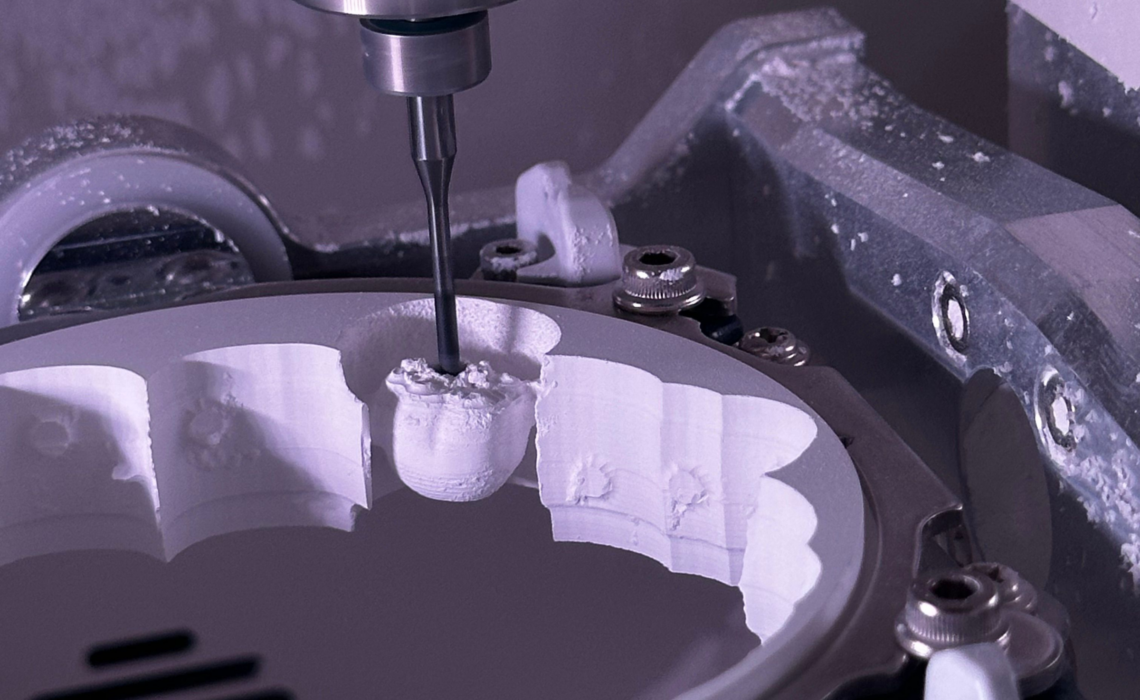
CNC machining has been around for decades, but some assumptions have not kept pace with what modern manufacturing can actually do.
It is still often seen as a process reserved for metal parts, final production, or expensive low-volume runs. In reality, CNC machining can support everything from functional prototyping to repeat production across a wide range of metals and engineering plastics.
For engineering teams, those outdated assumptions can lead to the wrong manufacturing decisions or to ruling out CNC before properly evaluating whether it fits the part.
Here are five of the most common CNC machining myths, and what engineering teams should consider instead.
Myth 1: CNC Machining Is Only for Metal Parts
CNC machining is strongly associated with materials such as aluminum and stainless steel, but its capabilities go well beyond metals.
Engineering plastics such as POM-C are routinely CNC machined for applications that require dimensional stability, low friction, strength, and precision. This makes them suitable for components across industrial equipment, automotive systems, robotics, and other demanding applications.
The decision to use CNC should therefore not start with the question: Does this part need to be metal?
A better question is whether the part requires the precision, repeatability, material properties, and surface quality that CNC machining can provide.
In many cases, the material follows the application requirements, not the manufacturing process.
Myth 2: CNC Machining Is Too Slow for Prototyping
Another common misconception is that CNC machining only makes sense once a design has been finalized.
In practice, CNC machining can be valuable during the prototyping phase, particularly when engineers need to test a part under realistic conditions.
3D printing is excellent for fast design iterations, form studies, and early prototypes. But when a team needs to understand how the final material will behave under mechanical loads, temperature, friction, or repeated use, a CNC-machined prototype can provide much more representative results.
This becomes particularly important when validating:
- Tight tolerances
- Mechanical strength
- Fit between components
- Surface requirements
- Production materials
- Real-world performance
Skipping functional validation may save time early in development, but it can also move problems further downstream, where changes are often more expensive.
The choice is not necessarily between additive manufacturing and CNC. Often, the best development process uses both.
Myth 3: CNC Machining Doesn’t Scale Economically
CNC machining is also frequently treated as a low-volume manufacturing method: useful for prototypes and small batches, but something injection molding should eventually replace that or another high-volume process.
That is not always the case.
CNC machining can support production volumes ranging from individual parts to hundreds or thousands of components, depending on the geometry, material, tolerances, and economics of the application.
For certain parts, CNC can remain competitive well into production particularly when tooling costs would otherwise be significant.
This matters for companies that need to:
- Launch production without committing to expensive tooling
- Manufacture lower or unpredictable volumes
- Make ongoing design changes
- Produce complex geometries
- Maintain tight tolerances
- Reduce inventory risk
Injection molding may ultimately make more sense at very high volumes, but there is no universal point at which CNC suddenly becomes the wrong process.
The economics need to be evaluated against the specific part and production requirement.
Myth 4: All CNC Machining Delivers the Same Quality
“CNC machining” is a broad category.
Two suppliers may both list CNC machining as a capability while offering very different levels of equipment, expertise, materials, tolerances, finishing, and quality control.
The manufacturing result can depend on factors such as:
- 3-axis versus multi-axis milling
- CNC turning capabilities
- Machine accuracy
- Available tooling
- Material quality and traceability
- Finishing processes
- Inspection procedures
- Quality and certification requirements
For rotational or cylindrical parts, for example, CNC turning may be the most efficient approach. More complex geometries may require multi-axis machining to reduce setups and achieve the required accuracy.
Material sourcing matters too. A component machined from certified aluminum or stainless steel is not automatically equivalent to one produced from material with limited traceability.
When selecting a CNC partner, the question should therefore go beyond whether they “offer CNC.”
The more important question is whether their specific manufacturing capabilities match the requirements of your part.
Myth 5: CNC Machining and 3D Printing Are Competing Technologies
CNC machining is sometimes positioned as the traditional alternative to additive manufacturing.
That creates a false choice.
In modern product development, CNC machining and 3D printing frequently complement each other.
A product might begin with additive manufacturing, because the design is changing quickly and engineers need rapid iterations. Once the geometry becomes more stable, CNC machining can be used to test the design in the intended production material and validate its mechanical performance.
From there, the production method may change again depending on volume, geometry, material requirements, lead time, and cost.
A typical product journey could look like:
3D printing → CNC machining → production
But it could just as easily move between manufacturing technologies several times.
The goal should not be to defend one process over another.
It should be to use the manufacturing method that makes the most sense at each stage of the product lifecycle.
What This Means for Your Next Manufacturing Decision
Many manufacturing myths started because they contained some truth at a certain point in time.
But manufacturing technologies, supply chains, automation, and production capabilities continue to evolve.
Treating CNC machining as inherently slow, expensive, metal-only, or disconnected from additive manufacturing can cause engineering teams to dismiss an option that may be well suited to their application.
Rather than starting with assumptions about the process, start with the part.
Consider:
- What tolerances are required?
- Which material properties matter?
- How many parts are needed?
- How quickly might the design change?
- What surface finish is required?
- Is tooling investment justified?
- Does the part need to perform like the final production component?
Those questions usually lead to a better manufacturing decision than choosing a process based on convention.
At Shapeways, we support engineering teams across the product lifecycle, combining digital manufacturing technologies including CNC milling, CNC turning, precision finishing, and additive manufacturing.
With materials including aluminum, stainless steel, and engineering plastics such as POM-C, we help teams move from early development through functional testing and into production.
The right manufacturing process is not about choosing CNC or additive.
It is about choosing the right process for the part, at the right moment.
Have a part you are evaluating for production? Talk to the Shapeways team about the best manufacturing route for your application.
Frequently Asked Questions About CNC Machining
Is CNC machining more expensive than 3D printing?
It depends on the part, material, geometry, and production volume.
For very small quantities or highly complex geometries, 3D printing may be more economical. CNC machining can become increasingly competitive when production volumes increase or when the part requires tight tolerances, specific mechanical properties, or production-grade materials.
The most economical process should therefore be evaluated part-by-part.
Can CNC machining produce complex geometries?
Yes. Modern CNC machining, particularly multi-axis milling, can produce highly complex parts with tight tolerances.
However, some internal channels, enclosed structures, and geometries that are difficult for cutting tools to access may be better suited to additive manufacturing.
This is one reason why CNC machining and additive manufacturing are increasingly used together, rather than treated as competing processes.
Which materials can be CNC machined?
CNC machining works with a wide range of metals and engineering plastics.
Common options include aluminum, stainless steel, and engineering thermoplastics such as POM-C.
The right material depends on the application’s mechanical requirements, environmental conditions, weight targets, corrosion resistance, friction, and surface finish.
Is CNC machining suitable for both prototypes and production?
Yes.
CNC machining can be used for functional prototypes, engineering validation, bridge production, low- and medium-volume manufacturing, and repeat production.
Using the same manufacturing process during testing and production can also allow engineering teams to evaluate parts that closely reflect the final material and mechanical properties.