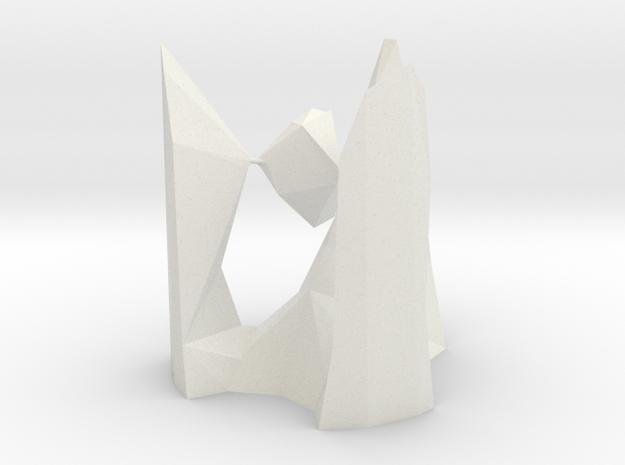
Models presented on Shapeways are recreations of a Classical Mathematical Model Collection originally made by hand in plaster in the 1800's. This portion of the collection was originally modelled by Carl Rodenberg under the direction of the famous mathematician Felix Klein.
Currently portions of the collection are on permanent display at The University of Hong Kong Department of Mathematics and were exhibited at the prestigious ACM SIGgraph Conference in 2008.
This project was begun in 1998. All images except where noted are of actual models. For more information see formpig.com. Kindly email us if you have specific requests/needs or would like to purchase the full set.
Cayley's Cubic Surface (9 lines of ruling and 1 demonstration line) [10]
The models presented on Shapeways are recreations of a Classical Mathematical Model Collection originally made by hand in plaster in the 1800's. This portion of the collection was originally modelled by Carl Rodenberg under the direction of the famous mathematician Felix Klein. The models are currently presented as solid 1:1 recreations.
For more information: http://formpig.com/blog/?cat=24 or
http://www.flickr.com/photos/52229863@N06/sets/72157626031842197/
Cubic with 4 - A1 Type Singularities (9 lines of ruling) [13]
The models presented on Shapeways are recreations of a Classical Mathematical Model Collection originally made by hand in plaster in the 1800's. This portion of the collection was originally modelled by Carl Rodenberg under the direction of the famous mathematician Felix Klein. The models are currently presented as solid 1:1 recreations.
For more information:
http://formpig.com/blog/?cat=24
http://www.flickr.com/photos/52229863@N06/sets/72157626031842197/
Affine Form of the Cubic with 4 - A1 Type Singularities (9 lines of ruling) [16]
The models presented on Shapeways are recreations of a Classical Mathematical Model Collection originally made by hand in plaster in the 1800's. This portion of the collection was originally modelled by Carl Rodenberg under the direction of the famous mathematician Felix Klein. The models are currently presented as solid 1:1 recreations.
For more information:
http://formpig.com/blog/?cat=24
http://www.flickr.com/photos/52229863@N06/sets/72157626031842197/
[15] Affine Form of the Cubic with 4 - A1 Type Singularities (9 lines of ruling)
The models presented on Shapeways are recreations of a Classical Mathematical Model Collection originally made by hand in plaster in the 1800's. This portion of the collection was originally modelled by Carl Rodenberg under the direction of the famous mathematician Felix Klein. The models are currently presented as solid 1:1 recreations.
For more information:
http://formpig.com/blog/?cat=24
http://www.flickr.com/photos/52229863@N06/sets/72157626031842197/
Affine Form of the Cubic with 4 - A1 Type Singularities (9 lines of ruling) [14]
The models presented on Shapeways are recreations of a Classical Mathematical Model Collection originally made by hand in plaster in the 1800's. This portion of the collection was originally modelled by Carl Rodenberg under the direction of the famous mathematician Felix Klein. The models are currently presented as solid 1:1 recreations.
For more information:
http://formpig.com/blog/?cat=24
http://www.flickr.com/photos/52229863@N06/sets/72157626031842197/
Affine Form of the Cubic with 4 - A1 Type Singularities (9 Lines) [17]
The models presented on Shapeways are recreations of a Classical Mathematical Model Collection originally made by hand in plaster in the 1800's. This portion of the collection was originally modelled by Carl Rodenberg under the direction of the famous mathematician Felix Klein. The models are currently presented as solid 1:1 recreations.
For more information:
http://formpig.com/blog/?cat=24
http://www.flickr.com/photos/52229863@N06/sets/72157626031842197/
Cubic with 3 - A1 Type Singularities seen from the Inside (12 lines of ruling) [18]
The models presented on Shapeways are recreations of a Classical Mathematical Model Collection originally made by hand in plaster in the 1800's. This portion of the collection was originally modelled by Carl Rodenberg under the direction of the famous mathematician Felix Klein. The models are currently presented as solid 1:1 recreations.
For more information:
http://formpig.com/blog/?cat=24
http://www.flickr.com/photos/52229863@N06/sets/72157626031842197/
Cubic with 3 - A1 Type Singularities seen from the Inside (12 Lines) [19]
The models presented on Shapeways are recreations of a Classical Mathematical Model Collection originally made by hand in plaster in the 1800's. This portion of the collection was originally modelled by Carl Rodenberg under the direction of the famous mathematician Felix Klein. The models are currently presented as solid 1:1 recreations.
For more information:
http://formpig.com/blog/?cat=24
http://www.flickr.com/photos/52229863@N06/sets/72157626031842197/
Cubic with an A2 Singularity (15 lines of ruling) [20]
The models presented on Shapeways are recreations of a Classical Mathematical Model Collection originally made by hand in plaster in the 1800's. This portion of the collection was originally modelled by Carl Rodenberg under the direction of the famous mathematician Felix Klein. The models are currently presented as solid 1:1 recreations.
For more information: http://formpig.com/blog/?cat=24 or
http://www.flickr.com/photos/52229863@N06/sets/72157626031842197/
Other Real form of the Cubic with an A2 Singularity (3 lines of ruling and 6 parabolic lines) [21]
The models presented on Shapeways are recreations of a Classical Mathematical Model Collection originally made by hand in plaster in the 1800's. This portion of the collection was originally modelled by Carl Rodenberg under the direction of the famous mathematician Felix Klein. The models are currently presented as solid 1:1 recreations.
For more information:
http://formpig.com/blog/?cat=24
http://www.flickr.com/photos/52229863@N06/sets/72157626031842197/
Cubic with 3 - A2 Singularities (3 lines of ruling) [22]
The models presented on Shapeways are recreations of a Classical Mathematical Model Collection originally made by hand in plaster in the 1800's. This portion of the collection was originally modelled by Carl Rodenberg under the direction of the famous mathematician Felix Klein. The models are currently presented as solid 1:1 recreations.
For more information:
http://formpig.com/blog/?cat=24
http://www.flickr.com/photos/52229863@N06/sets/72157626031842197/
Cubic with an A3 Singularity (2 lines of ruling) [23]
The models presented on Shapeways are recreations of a Classical Mathematical Model Collection originally made by hand in plaster in the 1800's. This portion of the collection was originally modelled by Carl Rodenberg under the direction of the famous math[ematician Felix Klein. The models are currently presented as solid 1:1 recreations.
For more information:
http://formpig.com/blog/?cat=24
http://www.flickr.com/photos/52229863@N06/sets/72157626031842197/
Cubic with an A3 and 2 - A1 Type Singularities (5 lines of ruling) [24]
The models presented on Shapeways are recreations of a Classical Mathematical Model Collection originally made by hand in plaster in the 1800's. This portion of the collection was originally modelled by Carl Rodenberg under the direction of the famous mathematician Felix Klein. The models are currently presented as solid 1:1 recreations.
For more information:
http://formpig.com/blog/?cat=24
http://www.flickr.com/photos/52229863@N06/sets/72157626031842197/
Cubic with an A4 and an A1 Type Singularity (4 lines of ruling) [25]
The models presented on Shapeways are recreations of a Classical Mathematical Model Collection originally made by hand in plaster in the 1800's. This portion of the collection was originally modelled by Carl Rodenberg under the direction of the famous mathematician Felix Klein. The models are currently presented as solid 1:1 recreations.
For more information:
http://formpig.com/blog/?cat=24
http://www.flickr.com/photos/52229863@N06/sets/72157626031842197/
Cubic with an A5 and an A1 Singularity (2 lines of ruling) [26]
The models presented on Shapeways are recreations of a Classical Mathematical Model Collection originally made by hand in plaster in the 1800's. This portion of the collection was originally modelled by Carl Rodenberg under the direction of the famous mathematician Felix Klein. The models are currently presented as solid 1:1 recreations.
For more information:
http://formpig.com/blog/?cat=24
http://www.flickr.com/photos/52229863@N06/sets/72157626031842197/
Cubic with a D4 Singularity (6 lines of ruling) [28]
The models presented on Shapeways are recreations of a Classical Mathematical Model Collection originally made by hand in plaster in the 1800's. This portion of the collection was originally modelled by Carl Rodenberg under the direction of the famous mathematician Felix Klein. The models are currently presented as solid 1:1 recreations.
For more information:
http://formpig.com/blog/?cat=24
http://www.flickr.com/photos/52229863@N06/sets/72157626031842197/
Other Real form of a Cubic with a D4 Singularity (2 lines and 2 parabolic lines) [29]
The models presented on Shapeways are recreations of a Classical Mathematical Model Collection originally made by hand in plaster in the 1800's. This portion of the collection was originally modelled by Carl Rodenberg under the direction of the famous mathematician Felix Klein. The models are currently presented as solid 1:1 recreations.
For more information:
http://formpig.com/blog/?cat=24
http://www.flickr.com/photos/52229863@N06/sets/72157626031842197/
Cubic with a D5 Singularity (2 lines of ruling and 1 parabolic line) [30]
The models presented on Shapeways are recreations of a Classical Mathematical Model Collection originally made by hand in plaster in the 1800's. This portion of the collection was originally modelled by Carl Rodenberg under the direction of the famous mathematician Felix Klein. The models are currently presented as solid 1:1 recreations.
For more information:
http://formpig.com/blog/?cat=24
http://www.flickr.com/photos/52229863@N06/sets/72157626031842197/
Cubic with an E6 Singularity (1 line of ruling and 1 parabolic line) [31]
The models presented on Shapeways are recreations of a Classical Mathematical Model Collection originally made by hand in plaster in the 1800's. This portion of the collection was originally modelled by Carl Rodenberg under the direction of the famous mathematician Felix Klein. The models are currently presented as solid 1:1 recreations.
Ruled Cubic Surface (infinite lines of ruling) [S20]
The models presented on Shapeways are recreations of a Classical Mathematical Model Collection originally made by hand in plaster in the 1800's. This portion of the collection was originally modelled by Carl Rodenberg under the direction of the famous mathematician Felix Klein. The models are currently presented as solid 1:1 recreations.
For more information:
http://formpig.com/blog/?cat=24
http://www.flickr.com/photos/52229863@N06/sets/72157626031842197/
Ruled Cubic Surface (infinite lines of ruling) [S21]
The models presented on Shapeways are recreations of a Classical Mathematical Model Collection originally made by hand in plaster in the 1800's. This portion of the collection was originally modelled by Carl Rodenberg under the direction of the famous mathematician Felix Klein. The models are currently presented as solid 1:1 recreations.
For more information:
http://formpig.com/blog/?cat=24
http://www.flickr.com/photos/52229863@N06/sets/72157626031842197/
Ruled Cubic Surface (infinite lines of ruling) [S22]
The models presented on Shapeways are recreations of a Classical Mathematical Model Collection originally made by hand in plaster in the 1800's. This portion of the collection was originally modelled by Carl Rodenberg under the direction of the famous mathematician Felix Klein. The models are currently presented as solid 1:1 recreations.
For more information:
http://formpig.com/blog/?cat=24
http://www.flickr.com/photos/52229863@N06/sets/72157626031842197/
The Clebsch Diagonal Surface is a non-singular (i.e. smooth) Cubic Surface originally discovered and documented by Alfred Clebsch (1833 - 1872). The Clebsch Diagonal is a historically important model and was of great interest to early machine designers and mathematicians.
This model is a recreation of the original plaster model made by hand in the 1800's under the direction of Felix Klein. This is a FULL SIZE 1:1 version.
It shows the 27 possible lines on a smooth cubic surface and is the "god-head" of the series of 23 types of singularities possible on a Cubic Surface (that are also shown on Shapeways).
All the lines are numbered with imprinted numbering of the complex configuration. In total there are 36 possible ways to number the lines.
This series of Clebsch models show various aspects of the complex configuration of geometric objects on this famous surface. Please see the model description to make sure which model contains which objects in the configuration. We'd also be happy to customize a model for you.
The Configuration:
27 total lines: 15 Diagonal Lines and 12 Horizontal Lines (Shafli's "Double Six")
30 points where 2 lines of ruling intersect
24 within the model and 6 at infinity
10 points where 3 lines of ruling intersect (Eckardt Points) -
7 within the model and 3 at infinity
The Sylvester Pentahedron
Additionally there are three "passages" which can be seen in the animation below. Three are "holes" that can be easily seen. Three are within the model at the "ears" and the seventh is somewhat vertical at the "waist".
For additional documentation or other models or sizes please contact the author. Note that while this is the "purest" model, some of the other Clebsch models show objects from the complex Configuration and one prints the imprinted numbers in a color process.
Clebsch Diagonal Surface with Configuration: 3 Horizontal and 3 Angled Planes. [01].
The Clebsch Diagonal Surface is a non-singular (i.e. smooth) Cubic Surface originally discovered and documented by Alfred Clebsch (1833 - 1872). The Clebsch Diagonal is a historically important model and was of great interest to early machine designers and mathematicians.
This model is a recreation of the original plaster model made by hand in the 1800's under the direction of Felix Klein. This is a FULL SIZE 1:1 version.
It shows the 27 possible lines on a smooth cubic surface and is the "god-head" of the series of 23 types of singularities possible on a Cubic Surface (that are also shown on Shapeways).
All the lines are numbered with imprinted numbering of the complex configuration. In total there are 36 possible ways to number the lines.
This series of Clebsch models show various aspects of the complex configuration of geometric objects on this famous surface. Please see the model description to make sure which model contains which objects in the configuration. We'd also be happy to customize a model for you.
The Configuration:
27 total lines: 15 Diagonal Lines and 12 Horizontal Lines (Shafli's "Double Six")
30 points where 2 lines of ruling intersect
24 within the model and 6 at infinity
10 points where 3 lines of ruling intersect (Eckardt Points) -
7 within the model and 3 at infinity
The Sylvester Pentahedron
Additionally there are three "passages" which can be seen in the animation below. Three are "holes" that can be easily seen. Three are within the model at the "ears" and the seventh is somewhat vertical at the "waist".
For additional documentation or other models or sizes please contact the author. Note that this models is the same as the Clebsch Diagonal Surface with Imprinted Numbers - with the addition of some of the geometric objects in the Configuration.
The Clebsch Diagonal Surface is a non-singular (i.e. smooth) Cubic Surface originally discovered and documented by Alfred Clebsch (1833 - 1872). The Clebsch Diagonal is a historically important model and was of great interest to early machine designers and mathematicians.
This model is a recreation of the original plaster model made by hand in the 1800's under the direction of Felix Klein. This is a FULL SIZE 1:1 version.
It shows the 27 possible lines on a smooth cubic surface and is the "god-head" of the series of 23 types of singularities possible on a Cubic Surface (that are also shown on Shapeways).
All the lines are numbered with imprinted numbering of the complex configuration. In total there are 36 possible ways to number the lines.
This series of Clebsch models show various aspects of the complex configuration of geometric objects on this famous surface. Please see the model description to make sure which model contains which objects in the configuration. We'd also be happy to customize a model for you.
The Configuration:
27 total lines: 15 Diagonal Lines and 12 Horizontal Lines (Shafli's "Double Six")
30 points where 2 lines of ruling intersect
24 within the model and 6 at infinity
10 points where 3 lines of ruling intersect (Eckardt Points) -
7 within the model and 3 at infinity
The Sylvester Pentahedron
Additionally there are three "passages" which can be seen in the animation below. Three are "holes" that can be easily seen. Three are within the model at the "ears" and the seventh is somewhat vertical at the "waist".
For additional documentation or other models or sizes please contact the author. Note that this models is the same as the Clebsch Diagonal Surface with Imprinted Numbers - with the addition of the numbers being produced in /color/ via a colored rapid prototyping process.
Clebsch Diagonal Surface with Configuration: 31 Spheres and 1 Sylvester Pentahedron [01].
The Clebsch Diagonal Surface is a non-singular (i.e. smooth) Cubic Surface originally discovered and documented by Alfred Clebsch (1833 - 1872). The Clebsch Diagonal is a historically important model and was of great interest to early machine designers and mathematicians.
This model is a recreation of the original plaster model made by hand in the 1800's under the direction of Felix Klein. This is a FULL SIZE 1:1 version.
It shows the 27 possible lines on a smooth cubic surface and is the "god-head" of the series of 23 types of singularities possible on a Cubic Surface (that are also shown on Shapeways).
All the lines are numbered with imprinted numbering of the complex configuration. In total there are 36 possible ways to number the lines.
This series of Clebsch models show various aspects of the complex configuration of geometric objects on this famous surface. Please see the model description to make sure which model contains which objects in the configuration. We'd also be happy to customize a model for you.
The Configuration:
27 total lines: 15 Diagonal Lines and 12 Horizontal Lines (Shafli's "Double Six")
30 points where 2 lines of ruling intersect
24 within the model and 6 at infinity
10 points where 3 lines of ruling intersect (Eckardt Points) -
7 within the model and 3 at infinity
The Sylvester Pentahedron
Additionally there are three "passages" which can be seen in the animation below. Three are "holes" that can be easily seen. Three are within the model at the "ears" and the seventh is somewhat vertical at the "waist".
For additional documentation or other models or sizes please contact the author. Note that this models is the same as the Clebsch Diagonal Surface with Imprinted Numbers - with the addition of some of the geometric objects in the Configuration.
Architekton with an A2 and 2 - A1 singularities
This sculpture is a result of the firm's research utilizing digital technologies and revolving around a classical mathematical model collection originally made by hand in plaster in the 1800's.
The image pictured is of a prototype produced in a medical grade, transparent SLA material.
Please inquire at info@formpig.com for more information on this work.
Architekton with an A2 and 2 - A1 singularities [YZ intersection].
This sculpture is a result of the firm's research utilizing digital technologies and revolving around a classical mathematical model collection originally made by hand in plaster in the 1800's.
The image pictured is of a prototype produced in a medical grade, transparent SLA material.
Please inquire at info@formpig.com for more information on this work.
Architekton with an A2 and 2 - A1 singularities [XYZ intersection]
This sculpture is a result of the firm's research utilizing digital technologies and revolving around a classical mathematical model collection originally made by hand in plaster in the 1800's.
The image pictured is of a prototype produced in a medical grade, transparent SLA material.
Please inquire at info@formpig.com for more information on this work.
(0)
From:$147.99
Shop Details
Universal Joint is a research based design-build firm based in Austin Texas.
Also be sure to see more information about these models on their influential blog at formpig.com
Expertise
3D modeler
Designer
Product designer
Artist
Don't miss Shapeways Live
Once a month we hold our live video chat with the Shapeways community.