thegarden1988

by Whystler
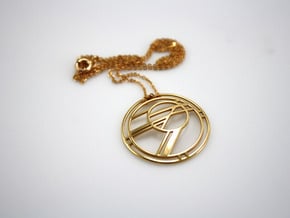
The nocturnal (or nocturlabe) is a very old instrument for telling time at night by measuring the stars. While concept is ancient, this design is all original. It is fully functional (all dials move properly) and meant to be worn as a pendant. This is now available for sale, as it has been tested and works nicely.

How to Use the Nocturnal:

The top of the nocturnal is where you see a bit of a ring around a spike. This ring can be strung with a chain and makes it possible to wear the nocturnal as a pendant. When reading the nocturnal, this end of the piece should always be up.

Your first step is to set the outermost dial on the date. The months are shown as letters, with January and December at the top, and the progression of the months running *counterclockwise*. Note that the exact position of the letter actually marks the middle of that month. Look closer at the piece and you will see the line that separates the months between the letters.

Now, hold your nocturnal up to the starry night sky, making sure that the date is still properly set. Locate the North Star centred in the hole in the middle of the Nocturnal. Then use the central dial (the one that looks like a pointer) to point to the two stars at the end of the bowl of the *big* dipper.

Once you have this all set. Look closer at the pointer and you will see that within the pointer is an eliptical ring and within this is a smaller pointer. This smaller pointer points to a roman numeral, which shows you the time.

Note again, that the roman numeral is centred on the middle of the hour. So, if the little pointer points in the centre of the numeral, it is in fact half past.

So now you can tell time at night without a powered time piece. This is great for night owls, vampires, and those who appreciate a gothic or steampunk look.
 
(49)  
  •  
From: $22.89
 
by TerraCotta
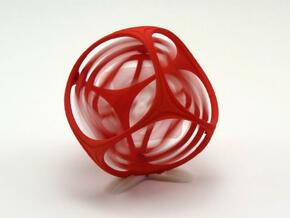
If M.C. Escher had owned fidget toys, he would have worn "One ring to rule the ball" as a pendant. A single, continuous line contains a small ball that makes orbit after mesmerizing orbit but cannot escape, always held down in four directions. Available in solid, durable stainless steel with optional antique bronze and gold plated finishes to fit any context, "One ring to rule the ball" now also includes a free rubber necklace so that you can confuse your mind any time the fancy strikes you! One customer echoes many others in saying, "I couldn't put it down. This thing is just too fun!"

Purchases by those gracious customers have now paid for the design time on this piece so it is available on a pay-what-you-want basis. Ordering from this page contributes 5$ towards continuing work such as the new, even more impossible "One ring to pwn the ball" (just released October 18th!) which can be found at http://www.shapeways.com/model/145172/one_ring_to_pwn_the_ball.html and the open-source "Ultimate Desk Toy" at http://www.shapeways.com/model/109166/ultimate_desk_toy.html . To download the original 3d file for your own use under a CC-BY license ( http://creativecommons.org/licenses/by/2.5/ca ) click "Download" at top right . To learn more about this design or other work from Terra Cotta, visit our website at http://www.terracottapf.com
 
(51)  
  •  
From: $19.04
 
by jayfisher
A detailed full color model of each of the first six planets (out to Saturn) and major moons of the Solar system, to (logrithmic) scale.
(Note: the full Solar System set of planets and moons is available as a set here)

All surfaces are reproduced from NASA imaging.
For size reference, Jupiter is 22mm (0.9 inch) diameter, and Earth is 11mm (0.45 inch) diameter.

This set is designed for use in orrery or other models of the solar system, and so to best present all planets while preserving scale, the scale has been compressed - a logrithmic scale instead of a linear scale. This means that if the model of a moon of Jupiter is larger than the model of Mercury but smaller than Mars, then you know that the real moon really is larger than Mercury and smaller than Mars, But the size diference is compressed - Jupiter, which is really more than ten times Earth's diameter, becomes only twice Earth's diameter, etc. This logrithmic scale allows all planets to be clearly visible together, while at the same time still indicating their sizes relative to each other.

The set contains six planets, and nine moons:
[In order of appearance in the photo above, right to left]
Mercury
Venus
Earth
 - Moon / Luna
Mars
Jupiter
 - Ganymede
 - Callisto
 - Io
 - Europa (attempt no landing there)
Saturn
 - rings of Saturn
 - Titan
 - Rhea
 - Iapetus
 - Dione

All objects have a 1.3mm (0.05 inch) hole at the south pole, about 3mm deep, for a brass axle (or a toothpick).

What color is a planet - is it color of its surface materials, or the colour of its atmosphere from space, or the color of the surface being colored by the atmosphere filtering light from the sun? The appearance in this set attempts to be that of the surface with moderate atmospheric influence, (with the gas giants depicted as the atmosphere and surface being the same thing). For example, this means that Venus depicts the features of its surface, but they are tinted somewhat by its atmosphere. Similarly, Earth and Titan show ground features, but some areas are tinted and obscured by atmosphere.

In areas where the model surface is more detailed than the most detailed NASA photography, the overall surface appearance conforms to what is known, but finer textural details are speculative. (Or, if there is an atmosphere, it is shown as particularly thick and opaque over the unmapped area.)

Due to hard limitations of the Shapeways 3D printer, the moon Dione is using the surface map of Rhea. I chose Dione because the surface is very similar to Rhea, and it is the most minor moon in the set. The alternative was simply to remove an object, but I preferred the set to include four of Saturn moons, like it does for Jupiter.
vBulletin statistics
 
(9)  
  •  
From: $22.11