Kampfflieger models

Designs by kampfflieger

kampfflieger is selling 53 products in 1/300 and 1/288 section

by kampfflieger
 
(1)  
  •  
From: $10.73
 
by kampfflieger
 
(0)  
  •  
From: $8.98
 
by kampfflieger
 
(3)  
  •  
From: $8.62
 
by kampfflieger
 
(0)  
  •  
From: $10.01
 
by kampfflieger
 
(1)  
  •  
From: $8.55
 
by kampfflieger
 
(0)  
  •  
From: $8.81
 
by kampfflieger
 
(0)  
  •  
From: $8.62
 
by kampfflieger
 
(1)  
  •  
From: $8.36
 
by kampfflieger
 
(0)  
  •  
From: $8.58
 
by kampfflieger
 
(2)  
  •  
From: $9.03
 
by kampfflieger
 
(0)  
  •  
From: $8.41
 
by kampfflieger
 
(2)  
  •  
From: $9.03
 
by kampfflieger
 
(1)  
  •  
From: $8.25
 
by kampfflieger
 
(1)  
  •  
From: $10.43
 
by kampfflieger
 
(1)  
  •  
From: $12.77
 
by kampfflieger
 
(0)  
  •  
From: $2.77
 
by kampfflieger
 
(0)  
  •  
From: $11.84
 
by kampfflieger
 
(1)  
  •  
From: $11.84
 
by kampfflieger
 
(1)  
  •  
From: $13.65
 
by kampfflieger
 
(0)  
  •  
From: $10.49
 
by kampfflieger
The Curtiss A-18 Model 76A Shrike II was a 1930s United States twin-engine ground-attack aircraft. They were assigned to the 8th Attack Squadron, 3rd Attack Group at Barksdale Field, Louisiana in 1937. The squadron won the coveted Harmon Trophy for gunnery and bombing accuracy in their first year of service. During its service with the 8th Attack Squadron, the retractable landing gear of the A-18 had an inherent weakness, with no less than eight of the 13 A-18s suffering from a landing gear collapse on landing or roll-out. The last of the A-18s with the 8th were replaced by early-model A-20 Havocs in 1941.
 
(0)  
  •  
From: $16.28
 
by kampfflieger
 
(0)  
  •  
From: $11.88
 
by kampfflieger
 
(0)  
  •  
From: $11.89
 
by kampfflieger
The A-8 was a low-wing monoplane ground-attack aircraft built by the United States company Curtiss, designed in response to a 1929 United States Army Air Corps requirement for an attack aircraft to replace the A-3 Falcon. The Model 59 "Shrike" was designated XA-8 (the "Shrike" nickname was not officially adopted).
 
(0)  
  •  
From: $12.19
 
by kampfflieger
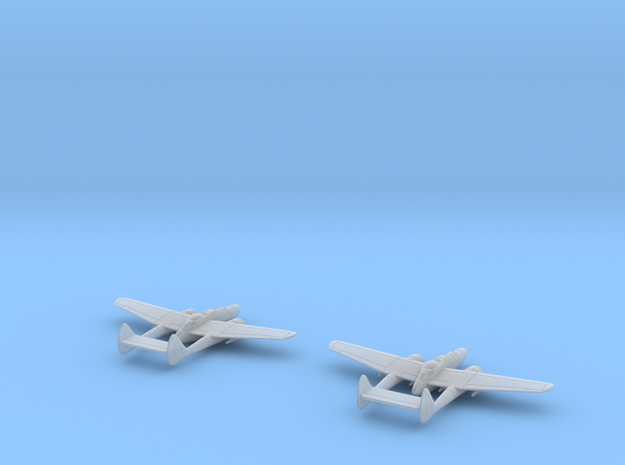
The Bell YFM-1 Airacuda was an American heavy fighter aircraft, developed by the Bell Aircraft Corporation during the mid 1930s. It was the first military aircraft produced by Bell. Originally designated the "Bell Model 1," the Airacuda first flew on 1 September 1937. The Airacuda was marked by bold design advances and considerable flaws that eventually grounded the aircraft. The Airacuda was Bell Aircraft's answer for a "bomber destroyer" aircraft. Although it did see limited production, and one fully operational squadron was eventually formed, only one prototype and 12 production models were ultimately built, in three slightly different versions.
 
(0)  
  •  
From: $15.07
 
by kampfflieger
Bristol F11/37 turret fighter, replacement for the Boulton Paul Defiant, F11/37 was won by another Boulton Paul design but was suspended when Derfiants started dropping like flies and the concept was seen to be flawed.
 
(1)  
  •  
From: $14.62
 
by kampfflieger
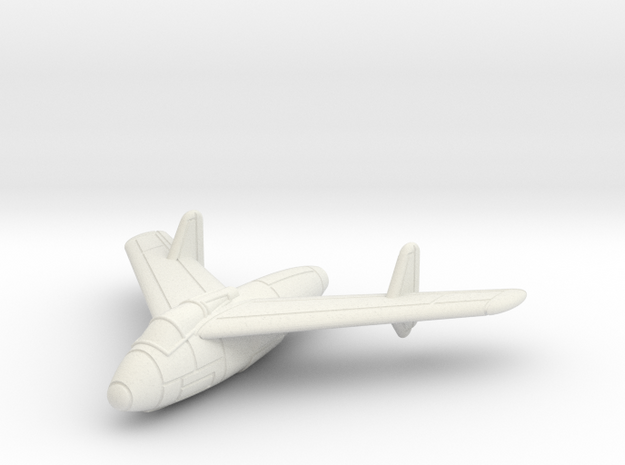
This Junkers design was submitted for the Emergency Fighter Competition in Febuary 1945. The fighter had air intakes at the fuselage sides to divert the boundry-layer air flow to a vent outlet aft of the cockpit fairing. The wings were of wooden construction, swept back 45 degrees and had two small vertical fins and rudders on the wing trailing edges. 540 liters (143 gallons) of fuel were contained in the wings, and a further 1025 liters (271 gallons) were contained in a fuselage tank located just behind the cockpit. A pressurized cockpit was provided with an ejector seat and armor (protection from 12.7 mm rounds from the front, and 20 mm rounds from the rear). Power was supplied by a Heinkel-Hirth HeS 011 jet engine, and two MK 108 30 mm cannon were installed in the sides of the fuselage nose with 100 rounds each, with a provision for two more. Good results were obtained with a completed wind tunnel model, and a mock-up fuselage with an HeS 011 jet was built for tests in which it was to be mounted above a Ju 88. An additional night fighter/all-weather fighter with a lengthened fuselage and room for a second crew member was also in the design phase, but neither project was completed due to the war's end.
 
(1)  
  •  
From: $10.02
 
by kampfflieger
 
(0)  
  •  
From: $9.62
 
by kampfflieger
 
(0)  
  •  
From: $13.04
 
by kampfflieger
 
(0)  
  •  
From: $21.43
 
by kampfflieger
 
(1)  
  •  
From: $11.89
 
by kampfflieger
The Douglas B-7 was a 1930s United States bomber aircraft. It was the first US monoplane given the B- 'bomber' designation. The monoplane was more practical and less expensive than the biplane, and the United States Army Air Corps chose to experiment with monoplanes for this reason.' Despite positive evaluation, the Y1B-7 never entered mass production because of its small bomb load and because newer, more capable aircraft, such as the Martin B-10, were under development. Nevertheless, six of the B-7 prototypes, the XO-35 prototype, and the five O-35s all participated in the Airmail Emergency of 1934. All of the O-35s survived and remained in service during the latter 1930s, but four of the B-7s were lost or scrapped in crashes delivering the mail. The surviving two were retired in late 1938 and January 1939.
 
(0)  
  •  
From: $15.14
 
by kampfflieger
 
(0)  
  •  
From: $9.75
 
by kampfflieger
The Boeing YB-9 was the first all-metal monoplane bomber aircraft designed for the United States Army Air Corps. The YB-9 was an enlarged alteration of Boeing's Model 200 Commercial Transport. The first of the five Y1B-9As entered service with the 20th and 49th Bombardment Squadrons, 2nd Bomb Group on 14 September 1932, with all being in service by the end of March 1933. The new bomber proved impossible to intercept during air exercises in May 1932, strengthening calls for improved air defense warning systems. Two B-9s were destroyed during crashes in 1933, one of the accidents being fatal, while the remaining aircraft were gradually phased out over the next two years, with the last being withdrawn on 26 April 1935.
 
(0)  
  •  
From: $12.37
 
by kampfflieger
 
(0)  
  •  
From: $8.88
 
by kampfflieger
The North American O-47 was an observation fixed-wing aircraft monoplane used by the United States Army Air Corps. It had a low-wing configuration, retractable landing gear and a three-blade propeller. Training maneuvers in 1941 demonstrated the shortcomings of the O-47. Light airplanes proved more capable of operating with ground troops, while fighters and twin-engine bombers showed greater ability to perform recon and photo duties. Thus, O-47s during World War II, except for those caught at overseas bases by the Japanese attacks, were relegated to such duties as towing targets, coastal patrol, and anti-submarine patrol.
 
(0)  
  •  
From: $13.28
 
Shop Details
der Kampfflieger scale models

Expertise

  • 3D modeler
  • Designer
  • Product designer