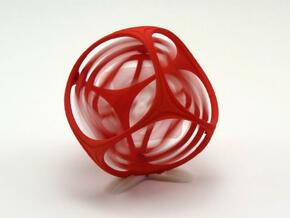
Check out gibell's Reuleaux solids at http://www.shapeways.com/model/115463/reuleaux_solids_3cm.html Those are surfaces of rotation based on Reuleaux polygons, which are curves of constant width. These are also surfaces of constant width, but *not* surfaces of rotation. So despite looking decidedly non-spherical, they roll smoothly as spheres.
There are two different Meissner solids, subtly different. Look closely at the edges. Some are rounded and some are sharp. One of them has the round edges making a a triangle and the sharp edges meeting at a point; the other has them the other way around.
These are sized for compatibility with gibell's solids, so if you get all five they will all roll smoothly under the same flat surface together. And like gibell's, they are hollow with internal braces to lend extra support, with holes in the bottom to let the support material out.
Printed great. Video below! (the two foreground shapes are mine; the red one in the background is one of gibell's from the set linked above)
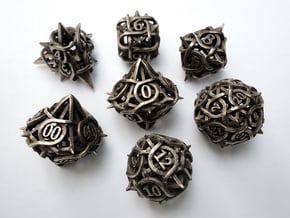
This prickly sphere looks amazing in 3D, you can lose your self for hours playing and being mesmerized by it. It doubles as an acupuncture ball, roll it around on your body ( I love it on my head) to relax and circulate your blood, the skin feels tingly afterwards.
There are six regular convex polytopes in 4D, which are analogous to the
five Platonic solids in 3D. This is the first, the pentachoron
or hyperpyramid, in a vertex-first projection. It has 5 tetrahedral
cells, and like the tetrahedron is its own dual.
In every dimension there's one polytope like this: all triangles, self-dual, analogous to the tetrahedron. As a group they're called simplexes, so this is the 4-simplex.
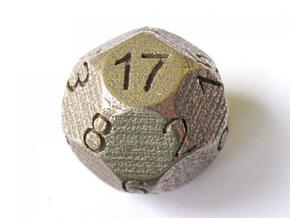
A die in the shape of the symbol PI. To make it even better this die is perfectly weighted and all sides are roughly the same landing area. If rolled on a flat surface this die will roll fair so you can actually use it.
A 5mm grided cube 50mm high.
It's a great desk toy for helping the creative juices.
The material it can be are restricted because of it size, please contact me with any questions?
Pick a time period in stock history, visualize the performance of the chosen stocks with a stock line chart diagram and use those lines as lead for the bracelet design.
This anti-subjective design solution questions the continuous obsession of the "genius" designer, the "form" generator by using a public economic network as source of pure form generation.
More information @ http://www.paulkweton.com/latest-projects/Embrace/
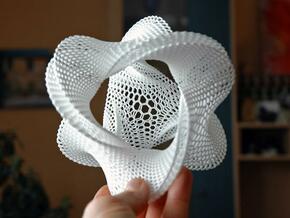
"Sphere within a sphere within a sphere" small sculpture with a moving ball within a ball (3 spheres in all). The surface consists of a structure formed from a voronoi pattern.
A 3D projection of the 24-cell, one of the 6 regular polytopes in four dimensions.
4D Polytopes (or polychora) are the 4-dimensional analogous of the 2D polygons and 3D polyhedra.
Regular polychora are composed of a finite set of cells (polyhedra), all regular and alike, surrounding each edge in an identical way.
We cannot see a 4D polytope, but we can project it in 3D (in the same way as we make a flat drawing of a polyhedron).
The 24-cell is composed of 24 regular octahedra.
This is a special central projection (perspective) of the polytope, in which no cells or edges intersect each other. It is also called a Schlegel diagram.
Algorithmically eroded virtual terrain, 0.2mm detail, bottom hollowed out to reduce volume, wall thickness: 2mm. On the underside is the reverse of the terrain: with lobed hilltops and steep valleys.
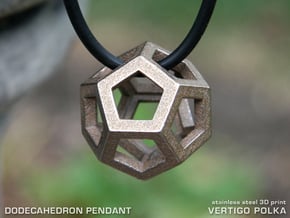
One of the five platonic solids. A wire-frame, regular dodecahedron, which has 12 regular pentagonal faces. A handy visual aid for anyone studying polyhedra or the platonic solids.